
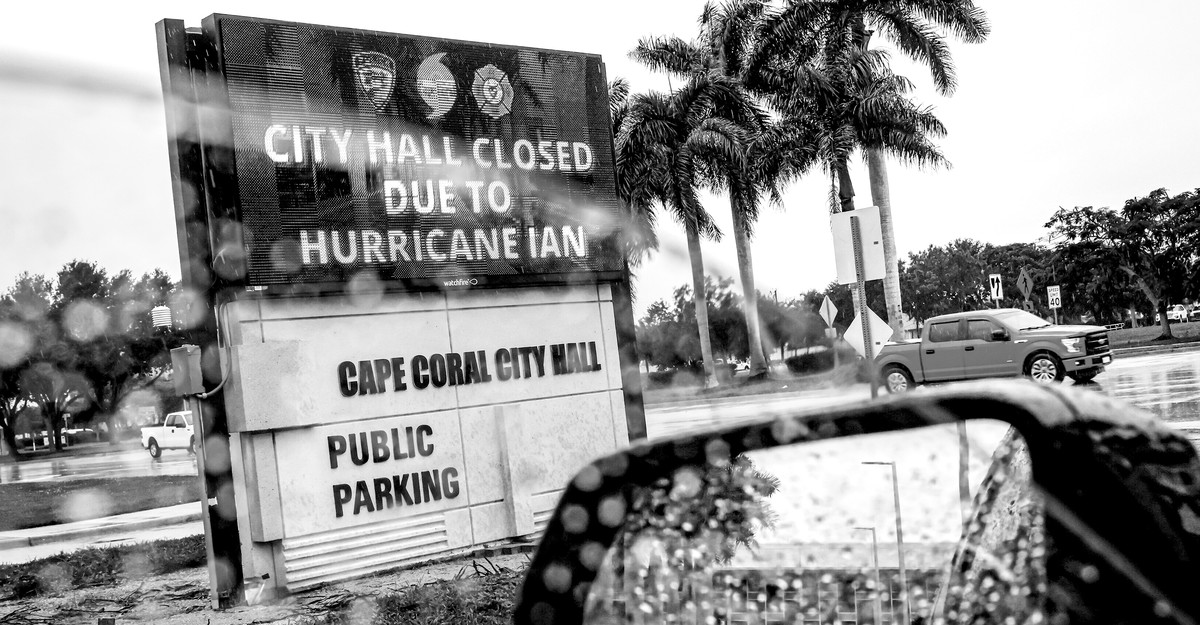
Five years ago, after Hurricane Irma pummeled Florida’s Gulf Coast, I rode a boat through the canals of Cape Coral, the “Waterfront Wonderland,” America’s fastest-growing city at the time. It was a sunny day with a gentle breeze and just a few puffs of clouds, so as I pointed to the blown-out lanais and piles of storm debris, my guide, a snowbird named Brian Tattersall, kept teasing me for missing the point of a magical afternoon. He said I sounded like his northern friends who always told him he was crazy to live in the Florida hurricane zone.
“Come on. Does this feel crazy?” he asked, as we drifted past some palm trees. Cape Coral is a low-lying, pancake-flat spit of exposed former swampland, honeycombed by an astonishing 400 miles of drainage ditches disguised as real-estate amenities, but to Tattersall it was a low-tax subtropical Venice where he could dock his 29-foot Sea Fox in the canal behind his house. When I asked if Irma would slow down the city’s population boom, he scoffed: “No way.”
Then he paused to reconsider. Irma had swerved away at the last minute, and even that near miss had made a big mess. “Look, if we get 15 feet of storm surge, holy shit, that would take out Cape Coral.”
Then he paused to re-reconsider. He sipped his beer in the sunlight.
“Eh, even then, no way.”
On Wednesday, Hurricane Ian hit Cape Coral, and although the worst storm surge was probably closer to 11 feet, it inundated almost the entire city and ravaged its…
