
Scams, and the con artists behind them, are forever evolving and becoming more sophisticated and harder to spot.
ACM has compiled a list of current scams identified on sites such as scamwatch.gov.au, cyber.gov.au and the Australian Competition and Consumer Commission’s website dedicated to informing people about fraudulent and dishonest activities.
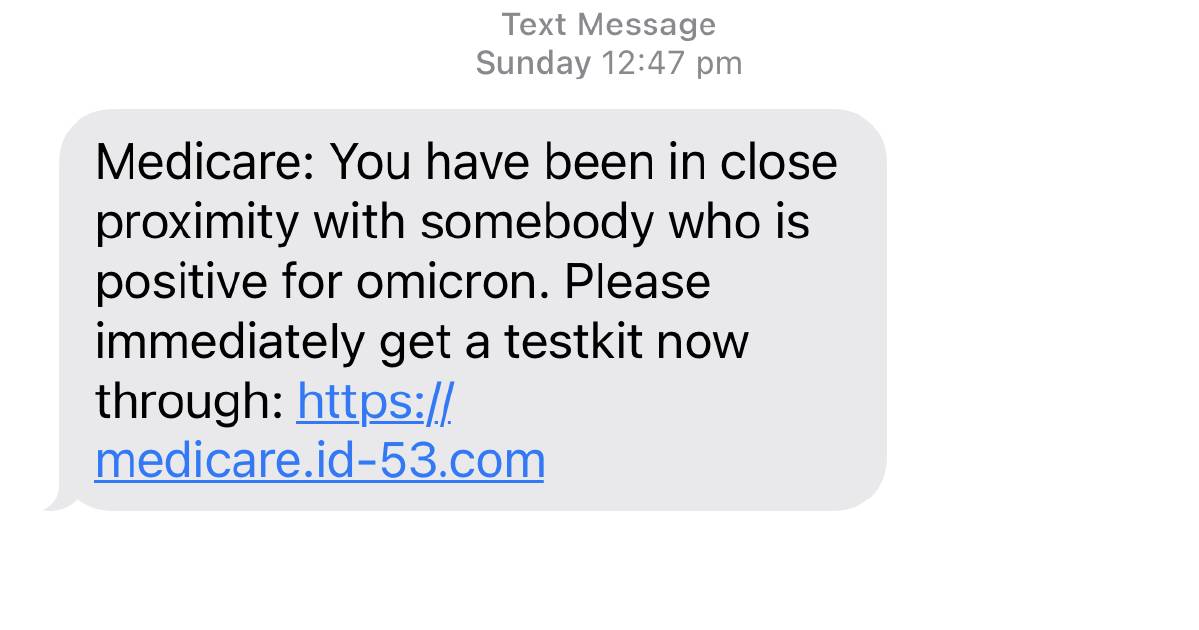
DON’T CLICK THE LINK: Test messages like this one, claiming to be from Medicare, are doing the rounds. Picture: Anna Wolf
- Fraudsters have ramped up text messaging scams that target Australians during the pandemic.
- The latest text phishing scam involves an SMS claiming to be from Medicare.
- The text identifies the recipient as a close contact of someone who has tested “positive for omicron” (sic).
- It advises the recipient to order a “testkit” via a link included in the message.
- People who received this message are advised not to clink on the link but to delete the text immediately.
- Scammers pretending to be government agencies providing information on COVID-19 through text messages and emails are “phishing” for your information.
- These contain malicious links and attachments designed to steal your personal and financial information.
- Don’t click on hyperlinks in text/social media messages or emails, even if they appear to come from a trusted source.
- Never respond to unsolicited messages and calls that ask for personal or financial details – just press delete or hang up.
- Never provide a stranger remote access to your computer, even if they claim to be from a telco company such as Telstra or the NBN Co.
- To verify the legitimacy of a contact, find them through an independent source such as a phone book, past bill or online search.
It’s a rental scam but with a twist

Scamwatch: Think before you click on the link
- Rental scams offering places to live have been doing the rounds on social media sites such as Facebook for quite a while but now there’s a new way scammers are avoiding detection.
- Traditionally these scams target people seeking new rental accommodation by offering fake rental properties to convince people into handing over money or personal information.
- The latest scam involves unsuspecting victims being hired to list a property for rent on classified sites.
- The target is being used as a rental mule to pass applicants’ personal information and money to a scammer.
- The scammer may reach out via social media and ask to employ such services as property management, social media expertise or general admin duties.
- They may say that they own multiple properties and want to use a private manager to handle their affairs’ for a fee.
- The scammer may also say they wish to avoid paying ‘exorbitant’ fees associated with professional real estate agents.
- Scamwatch is urging people to be cautious of such advertisements or tactics.
- Scamwatch has issued a warning to anyone who has lost money to scams, not to be fooled twice by fraudulent behaviour.
- If you’ve lost money to a scam, beware of anyone who approaches you and offers to help get your money back.
- These scams target people who have already lost money to a previous scam by promising to help victims recover their losses after paying a fee in advance.
Scams associated with online shopping

THINK TWICE: Consumers are being urged to be vigilant to scams associated with online shopping and mid year sales. Picture: Scamwatch via Twitter
- People looking to capitalise on mid-year online sales are being urged to watch out for the latest associated scams doing the rounds.
- According to scamwatch.gov.au shoppers in a rush to secure discount prices associated with mid-year sales are more likely to fall victim to scams.
- Australia Post is warning that scammers are trying to impersonate the postal service with fraudulent text messages alerting to a parcel delivery.
- The text may say that delivery is unlikely to occur that day and will provide a link to various options for parcel retrieval.
- This text message is known as a phishing scam and should be deleted immediately.
- Phishing messages are designed to look genuine, and often copy the format used by the organisation the scammer is pretending to represent, including their branding and logo.
- Consumers are also being warned of fake online deals during the sales season.
- Australians lost more than $12.9 million to such scams in 2021.
- In an online shopping scam, scammers create realistic looking fake online stores selling items at heavily discounted prices, however the items are fake, or never delivered to buyers.
- Scammers have also created fake stores on social media platforms or post fake ads on legitimate classifieds websites. They may request payment or offer discounts for payments made through direct bank transfers or cryptocurrency.
- Some scammers try to make online stores look legitimate by requesting payment via PayPal or credit card, always double check that the real PayPal platform is being used.

Scamwatch: Think before you click on the link
- It ‘s tax time and unfortunately that means there are several news tax related scams doing the rounds.
- The Tax Practitioners Board (TPB) is warning people to be extra vigilant of scams aiming to lure unsuspecting honest consumers into using the tax services of unregistered preparers.
- According to the TPB, unregistered preparers operate outside of the law, often making money by skimming a portion of their clients’ refunds and charging inflated fees for return preparation services.
- They attract new clients by promising large refunds.
- Some will encourage filing fraudulent claims for refunds on items that their clients aren’t entitled to, while others will obtain myGov sign in details from clients, putting their personal information at risk.
- The TPB recommends visiting its website for its online guide which offers tips for avoiding unregistered preparers.
- Check your tax practitioner is registered on the public register at tpb.gov.au/onlineregister.
- Only registered tax practitioners can charge a fee for tax agent services.
- Be sceptical if an agent offers to secure you unexpected or unexplained payments.
- Never share your myGov password with anyone, even your registered tax agent – doing so puts your personal information at risk.
- You should not allow anyone else to lodge or prepare your tax return through your myGov account.
- Visit www.tpb.gov.au/tpb-taxtime-2022 for more information on unregistered preparers and related scams.
- You can report scams to www.scamwatch.gov.au
Criminals targeting job seekers

Scamwatch: Think before you click on the link
- Queensland Police, the Australian Federal Police and Australian Border Force are warning the community to be vigilant online, following investigations identifying criminals are using social media to recruit people to unknowingly act as drug couriers.
- Investigators are warning that international drug syndicates are turning to social media platforms to recruit job hunters, to unknowingly receive, store or transport international packages containing illicit drugs.
- In one failed drug smuggling attempt, investigators stopped a Brisbane man, who thought he had accepted an online job offer delivering packages for a construction company, from transporting 2 kilograms of methylamphetamine concealed in an international parcel. The man had been approached after posting a work wanted ad online and was offered $250 for each delivery.
- According to police, the trend is not unique to Queensland and criminals are targeting people from across Australia.
- Investigators are encouraging the community to stay vigilant by researching any potential employer and conducting your own background checks to ensure their details and offer are legitimate and lawful.
- Conduct your own independent checks such as verifying the organisation’s contact details, website and checking their ABN if based in Australia.
- A reverse image search of a profile picture can also be a useful research tool.
- If you have been the victim of a cybercrime, you can report this online at ReportCyber at www.cyber.gov.au/acsc/report or via Scamwatch at www.scamwatch.gov.au

SCAM: The ATO will never send you an email or SMS with a link to log in to online services.
- The Australian Taxation Office is warning of an increase in email phishing scams claiming to be from the ATO.
- These scams tell people their ‘2022 tax lodgment’ has been received.
- The email asks them to open an attachment to sign a document and complete their ‘to do list details’.
- Opening the attachment takes you to a fake Microsoft login page designed to steal your login details. Entering your password could give the scammer access to your Microsoft account, allowing them to reset your passwords for other accounts like banking and online shopping.
- If you get an email like this, don’t click on any links or open any attachments. Forward the email to ReportEmailFraud@ato.gov.au, and then delete it.
- The real ATO will never send you an email or SMS with a link to log in to online services.
- And while the organisation may use email or SMS to ask you to contact them, they will never send an unsolicited message asking you to return personal identifying information through these channels.
Fake TFN/ABN application scams
- The ATO is also warning people to be on the look out for scams involving fake tax file number (TFN) applications.
- These scams tell people they can help them get a TFN for a fee. But instead of delivering this service, these fraudulent websites steal the person’s money and personal information.
- Such scams are often advertised on social media platforms like Facebook, Twitter and Instagram.
- Applying for a TFN is free. Visit: www.ato.gov.au/Individuals/Tax-file-number/Apply-for-a-TFN/
Jobs and employment scams
These types of scams are not knew but are doing the rounds once again.
- Job seekers are being urged to watch out for fake employment scams that offer ‘guaranteed’ ways to make lots of money, very fast, according to Scamwatch.
- The scammer contacts you by email, letter or phone and offers you a job that requires very little effort for high returns, or a guaranteed way to make money quickly….
