
Scams, and the con artists behind them, are forever evolving and becoming more sophisticated and harder to spot.
ACM has compiled a list of current scams identified on sites such as scamwatch.gov.au, cyber.gov.au and the Australian Competition and Consumer Commission’s website dedicated to informing people about fraudulent and dishonest activities.
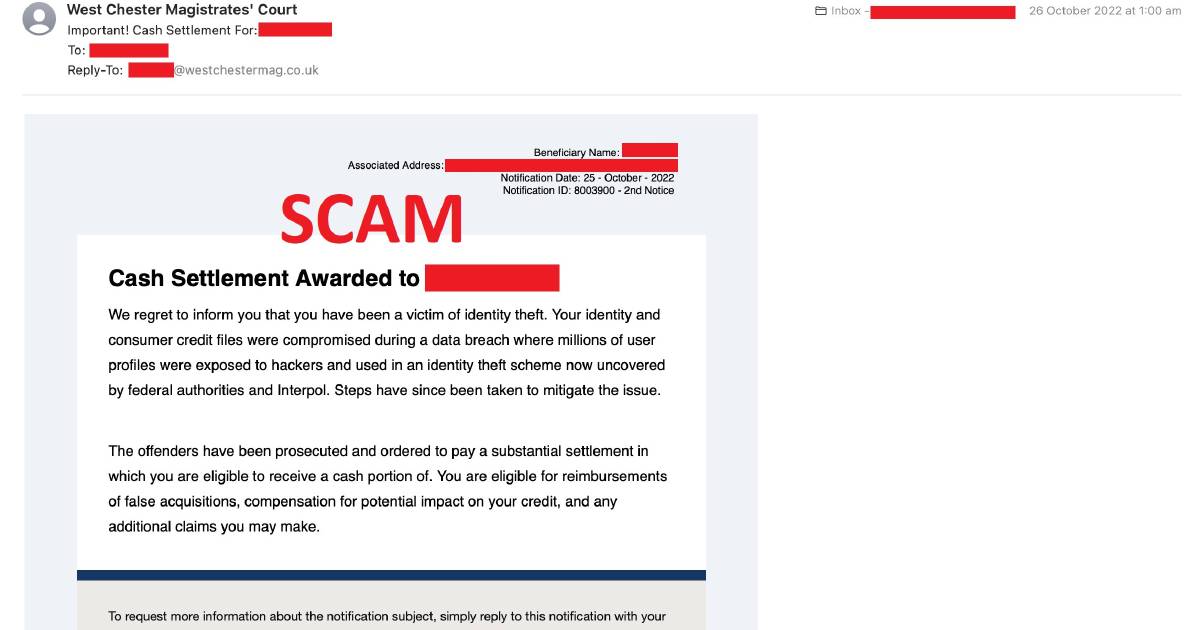
International court scam email
- Scamwatch is warning consumers of a scam email making the rounds purporting to be from international courts claiming they are eligible for compensation for identity theft. The email states the receiver is a victim of identity theft and that they are “eligible for reimbursements”.
- This email is a scam. Do not click on any links in the email. Do not give scammers your personal information. Delete the email.
Increase in scam activity after Optus data breach
- Scammers are impersonating Optus in various scams following the data breach.
- Beware of emails warning of payment errors or threatening email account closures, and callers offering a reward due to the data breach.
- Scammers may impersonate your bank or a service provider and warn you about “suspicious” activity on your account. Hang up and call the organisation using a number you’ve searched yourself.
- Watch out for phishing texts impersonating Optus and using the data breach to prompt you to update your MyGov details via a link. Never click on the link. Go directly to your MyGov account through the official MyGov website to check for a message in your inbox.

Unpaid toll text and email scam
- Since March, Scamwatch has received more than 4500 reports about unpaid toll road phishing scams, resulting in more than $250,000 in reported losses.
- If you receive a text message or email like stating “LINKT: your account failed to recharge automatically” and to “verify your information to prevent access from being blocked” do not click on links in the message. Instead, go to the official website or Linkt app and check your account information.
Stop, think and act to protect your information
- Beware of scam callers claiming you have been hacked and requesting remote access to your computer to fix the problem. If you are unsure, hang up and call the organisation they claim to be from using a number you’ve found yourself.
- Three ways to avoid scams is to ‘stop’ – don’t give away money or personal information if you are not sure where it is going – to ‘think’ – don’t click on links or respond to callers before you know it is legitimate – and to ‘protect’ – act quickly, call your bank to secure your accounts. See help and report scams.

- Scamwatch is warning people to beware of emails purporting to be from international courts claiming the recipient may eligible for compensation for identity theft. This is a scam.
- The organisation is also reminding people to watch for attempts at identity theft.
- The warning comes after high profile security incidents such as the Optus and Medibank data breaches.
- According to Scamwatch, there are several common methods of identity theft. The first one is phishing – where the scammer tricks you into handing over personal information. Another form is hacking where the scammer gains access to information by exploiting security weaknesses on your computer, mobile device or network. Scammers can also obtain information when they hack into business or government accounts.
- Other methods include remote access scams – where the scammer tricks you into giving access to your computer and paying for a service you don’t need or malware & ransomware where malware tricks you into installing software that allows scammers to access files and track what you are doing, while ransomware demands payment to ‘unlock’ computer or files. Fake online profiles can also be used. The scammer sets up a fake profile on a social media or dating site and sends you a ‘friend’ request.
- Finally, document theft which allows the scammer to gain access to private information through unlocked mailboxes or discarded personal documents such as utility bills, insurance renewals or health care records and data breaches can mean the scammer obtains data through accidental data breaches of business or government accounts.
Farm businesses warned of scams targeting agricultural sector

- Farmers and small businesses in rural and regional areas are urged to be cautious, particularly when buying heavy machinery, following a spike in scams targeting the agricultural sector this year.
- Reports to the ACCC’s Scamwatch show Australian farm businesses lost more than $1.2 million to scammers between January 1 and August 31, 2022, an increase of more than 20 per cent compared to the same period last year.
- The most common scam targeting farmers involved the sale of tractors and heavy machinery, with losses to this scam alone topping $1 million so far this year.
- Scammers are ruthlessly luring farmers and rural businesses with seemingly good online deals on tractors and other farm machinery through fake websites or bogus classifieds on legitimate platforms and publications.
- Scammers trick people through a range of ever-evolving methods such as providing a contract of sale, answering questions about the potential sale of machinery by phone or email, or offering a free trial period once money is deposited into an escrow account, which is actually part of the scam.
- Independently verifying the existence of a business by searching the address of the business and calling a nearby business, is an important step in ensuring the seller is who they say they are.
- Farmers are also being warned against giving too much personal information as scammers are targeting more than just money.
- Businesses, regardless of whether they have lost money, are encouraged to report scams and learn more about how to get help on the Scamwatch website scamwatch.gov.au.
Action to take after Optus data breach
Scamwatch is warning Australians to be on the lookout for increased scam activity following the Optus data breach in September.
For some customers, identity document numbers such as driver’s licence or passport numbers could be in the hands of criminals. It is important to be aware that you be may be at risk of identity theft and take urgent action to prevent harm.
This action should include:
- Secure and monitor your devices and accounts for unusual activity, and ensure they have the latest security updates.
- Enable multi-factor authentication for all accounts.
Be alert for scams referencing the Optus data breach. Learn how to protect yourself from scams by visiting www.scamwatch.gov.au.
If you are concerned that your identity has been compromised or you have been a victim of a scam, contact your bank immediately and call IDCARE on 1800 595 160.
The Australian Government says passports are still safe to use. Optus has agreed to reimburse the costs associated with replacing a passport due to the breach.
Service NSW said you only need to replace your NSW driver licence if Optus has notified you that both your driver licence number and the card number have been compromised.
Steps you can take to protect your personal information: secure your devices and monitor for unusual activity; change your online account passwords and enable multi factor authentication for banking; check your accounts for unusual activity such as items you haven’t purchased; place limits on your accounts or ask you bank how you can secure your money; if you suspect fraud you can request a ban on your credit report.
If you think you may be affected by the recent Optus data breach contact Optus Customer service on 133 937. For more information, see Optus Data Breach.

Consumers urged to watch for scams after Optus data breach
- Scamwatch is warning Australians to be on the lookout for increased scam activity following the recent Optus data breach.
- If you are an Optus customer your name, date of birth, phone number, email addresses may have been released.
- For some customers identity document numbers such as driver’s licence or passport numbers could be in the hands of criminals. It is important to be aware that you be may be at risk of identity theft and take urgent action to prevent harm.
- Scammers will use the data breach and target people in any way that they can. You will likely notice an increased number of phishing emails, phone calls, and SMS or social media messages.
- Be wary of new communications and don’t just accept what you’re being told, and do not click any links or open any attachments.
- Optus customers should take immediate steps to secure all of their accounts, particularly their bank and financial accounts. You should also monitor for unusual activity on your accounts and watch out for contact by scammers.
- Steps you can take to protect your personal information: secure your devices and monitor for unusual activity; change your online account passwords and enable multi factor authentication for banking; check your accounts for unusual activity such as items you haven’t purchased; place limits on your accounts or ask you bank how you can secure your money; if you suspect fraud you can request a ban on your credit report.
- More information about how to protect yourself is available on the OAIC…
