
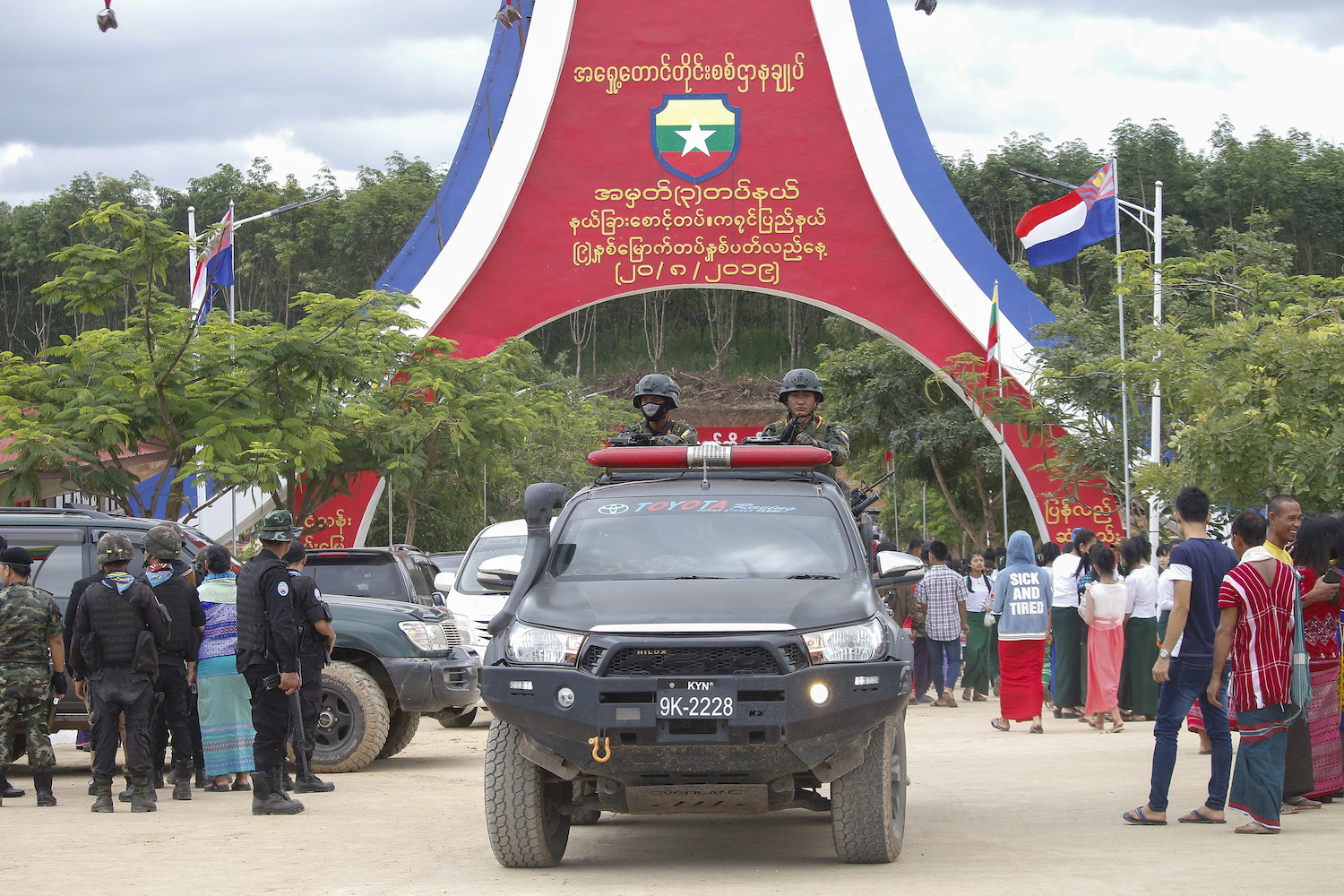
The Karen Border Guard Force is providing the military with frontline soldiers in exchange for business protection, allowing its “new city” project to emerge as a hub for online scams.
By FRONTIER
When Ma Moe Pyae Soe visited Shwe Kokko in February, during the Lunar New Year festival, she felt like she’d been transported to China. “Everywhere I looked, there were red festive lanterns, Chinese-language signs and Chinese people,” said the woman, who was visiting a friend in the area. She told Frontier she was also staggered at the scale of the new city of high-rise hotels and gaudy casinos that, in less than four years, had sprouted up on this obscure stretch of the Thai-Myanmar border in Kayin State.
Shwe Kokko Myaing, to give the place its full name, sits on a bend of the Thaung Yin River that divides Myanmar from Thailand. It is 16 kilometres north of the trade hub of Myawaddy, opposite the Thai city of Mae Sot. Frontier drove north of Mae Sot in late April, to view the new city from the Thai side of the river and see how it had changed since a visit to the area two years before. In place of dusty construction sites were gleaming multistorey hotels with neon signs in Burmese and Chinese, and workers were scaling the scaffolding of new buildings under construction.
The new city project – a partnership between an expatriate Chinese investor and an ethnic Karen Border Guard Force under the Myanmar military – has clearly enjoyed a reversal in fortunes since a Myanmar government probe in 2020 brought the seemingly illegal construction work to a halt. Interviews with residents and workers revealed a booming economy fuelled by Chinese money.
U Myo Naing*, a security guard at Shwe Kokko who spoke to Frontier while visiting family in Mae Sot, said he and other workers were paid in Chinese currency. His monthly salary of 2,900 yuan (K802,000, or US$433) was well beyond what he could earn elsewhere in Myanmar, even in the commercial capital Yangon. A Shwe Kokko resident, Saw Naing Tin*, said that, in 2020, the yuan became the de facto local currency – a phenomenon formerly unheard of outside of areas of Myanmar on the Chinese border. “Previously, we used only Myanmar or Thai currency,” he said, adding that the transition was due to “more and more Chinese people coming to do business with Chinese workers”.
An official at the Department of Immigration in Myawaddy, who asked not to be named, told Frontier in May that there were 1,225 Chinese nationals legally residing at Shwe Kokko. An unknown number are believed to be working there illegally. A report by the Karen Peace Support Network, a civil society group, in March 2020 estimated up to 10,000 mostly illegal Chinese workers, although the subsequent COVID-19 pandemic has since altered informal migration patterns.
Even less clear, at first, was the source of Shwe Kokko’s newfound wealth. Myo Naing claimed not to know what happened in the building he was paid to guard, and Naing Tin said that he and the other residents of the original village settlement of Shwe Kokko were barred from entering the new city without prior permission from the BGF, which keeps tight control over the area.
A March 2020 report by Brussels-based think tank the International Crisis Group said the presence of “thousands of Chinese-speaking white-collar workers” and the installation of “high-capacity internet connections” suggested the new city was being built as a front for online gambling aimed at people in China, where the practice is banned but demand remains huge. In previous years, the Philippines and Cambodia had emerged as hubs for the industry, estimated to be worth $24 billion a year across Asia, but when Beijing pressured these countries to crack down on online gambling in 2019, many operators sought safe havens elsewhere. The lawless environment of Shwe Kokko, in a border area carved up between different armed groups in a multi-decade civil war, meant it could provide such a haven.
Despite this possibility, evidence for online gambling at Shwe Kokko has so far been only circumstantial. However, investigations by Frontier have found what appears to be a growing industry of online scams operating from the new city, of which gambling may only be a part.
‘We have to pretend not to know’
Ma Su*, an accountant at a Chinese firm in Shwe Kokko, said companies there were recruiting people to work as online scammers, often under false pretences. “Workers recruited online are told they will earn a good salary at a casino, but [on arrival] are ordered to work as scammers instead,” she told Frontier. Those who refuse have to pay hefty sums in “compensation” to their new bosses, she said, and attempts at escape are regularly thwarted by the tight security around each business; prostitution charges are sometimes filed in retaliation against female recruits.
Ma Su said that although there are “many such cases of human trafficking” in the new city, legitimately employed workers such as herself were often too fearful to speak openly about them. “We are working and living in the area, so we have to pretend not to know some things,” she said.
Human trafficking for scamming operations is not new to Shwe Kokko. Via Ma Su, Frontier spoke to Ko Aung Myint*, a 32-year-old man from the town of Heho in southern Shan State, who said he arrived in the new city in April 2020 to start what he thought would be a casino job paying 5,000 yuan a month. He was ushered into a multistorey building with a suspiciously heavy deployment of armed BGF soldiers and private Chinese security guards.
“As soon as I entered, the Chinese [supervisor], who spoke a little Burmese, explained the business concept,” Aung Myint said. This concept did not involve gambling but the use of fake accounts and pre-prepared scripts on online platforms such as Facebook, Tinder and WhatsApp to lure people into fraudulent get-rich-quick schemes. “I told them I wouldn’t do it and wanted to leave, but they said I had to pay them first,” he said.
Aung Myint couldn’t afford the 30,000 baht (US$851) ransom they were demanding, particularly after having sold some of his belongings to pay 10,000 baht to secure the supposed casino job to a Myawaddy-based broker, who disappeared after escorting him to Shwe Kokko. “They [the bosses] told me that if I were a woman, I could take on sex work, but for men, there was no other choice. I wouldn’t be allowed to leave the job without paying them compensation,” he said.
After witnessing some staff being physically assaulted, Aung Myint feared for his life. He phoned family members, who then contacted U Thant Zin Aung, a lawmaker for Myawaddy Township in the Kayin State parliament. The MP, who was from the National League for Democracy, negotiated with the BGF and only two days after Aung Myint’s arrival at Shwe Kokko he was escorted to freedom without having to pay the ransom.
Aung Myint is conscious of how lucky he was to have an elected MP fighting his case, when, less than a year later, lawmakers were all deposed by the military coup of February 1, 2021. Dozens of them were arrested, driven into hiding or killed. “I was released because my case took place before the coup,” he said, adding that people being trafficked into Shwe Kokko now have little prospect of being rescued.
There have been more recent reports of human trafficking in the area. The Bangkok Post reported in April that two Thai women had escaped across the river to Mae Sot from a casino on the Myanmar side of the border. They told Thai police they had been forced into sex work after being told they would receive public relations or non-sexual entertainment jobs, and could only be released if they each paid a 25,000-baht ransom. One of the women said about 300 Thai women were trapped in the same circumstances. The casino wasn’t named, but its proximity to Mae Sot suggests it was one of the at least 18 casinos on BGF-controlled land just north of Myawaddy, rather than at Shwe Kokko.
While Aung Myint was tricked into a scamming job, recent Burmese and Chinese language job adverts from Shwe Kokko on Facebook are a little more upfront about the nature of the work.
On June 10, through a simple search using keywords, Frontier viewed several dozen of these adverts that were posted within the last month in job-seeking Facebook groups, mostly by accounts with limited personal information and generic photos, indicating they may be inauthentic. Several of the Chinese language groups were dedicated to Shwe Kokko and had several thousand members each. A search of Chinese social media platforms, however, yielded no relevant results, possibly due to automatic censorship.
The posts in Chinese were seeking Chinese-speaking applicants, while those in Burmese were looking for people with English or Chinese skills, with the latter being promised higher salaries. Many of both the Burmese and Chinese language posts contained the same assurances that no contract, deposit or proof of ID was required to get the job, and that no compensation had to be paid by those who later wished to quit – an apparent effort to pre-empt human trafficking concerns. All invited further enquiries via Telegram, a messaging platform known for its privacy and limited content moderation.
Most of the job descriptions described vague “marketing” and “customer service” roles, and none explicitly mentioned scamming. However, they contained hints that were later confirmed through private contact with a recruiter.
Several Chinese language posts on the same group advertised for a “User Growth Specialist” to work “on the early part of the luring chain”. Two Burmese language posts, from May 30 and June 4 respectively, described the role as “Customer service…
