
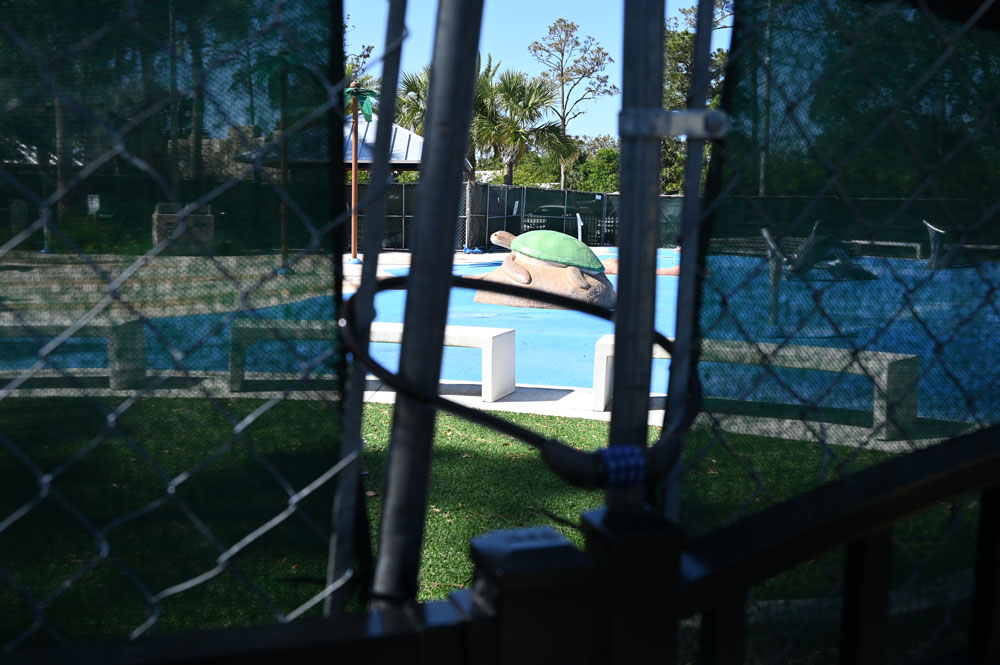
Palm Coast’s much-vaunted $5.1 million splash pad at Holland Park hadn’t yet opened less than a year ago before it began curdling into a boondoggle.
It opened for barely a few weeks before failing twice, closing the second time in July and soon after closing for good. The failure is causing the city to threaten a lawsuit against the contractor and designer of the splash pad and consider scraping off the whole thing and replacing it with more traditional, less breakdown-prone amenities.

For users of Holland Park, the city’s most popular amenity by far, and for city government, this is only the latest in a long history of setbacks dating back to February 2015, when Holland Park’s 27 acres closed for what was to be just 15 months for $4.3 million top-to-bottom renovations, but stayed closed for twice that long. The contractor on the job failed then, in the city’s view, and was fired before city crews completed the job. That was only the first phase of renovations. Splash pad construction was Phase Two, a $6 million job that, between it and Covid, again closed the park for weeks and months at a time. (The balance between the cost of the splash pad and the rest went to new bocce ball courts and other improvements unrelated to the pad.)
Since the splash pad was closed off last summer, a thick greenish tarp-like screen wraps around the fence around its 10,500 square feet–a huge portion of the park running through its center, deadening its usually vibrant community. The splash pad may need need $600,000 in repairs, according to the contractor, a figure as fluid as the pad has been dry.
Even before the splash park opened in May 2021, there were several areas of concern in water quality and color fading of the surface layer. The design team, S&ME, met with the contractor, BBI Construction management, and a BBI subcontractor called, ironically, No Fault, a Baton Rouge, La.-based company that specializes in playground and splash pad construction. No Fault boasts of installing 15 million square feet of “safety surface” in playgrounds in seven countries since 1974. Contractors told the city that “these concerns were a part of a break in process,” according to Deputy City Manager Lauren Johnston, describing the concerns as “an aesthetic issue only” that would be resolved with more usage of the splash pad. That proved not to be the case.

But BBI’s water-quality tests all passed inspection. So the splash pad opened. (See: “At Holland Park, Lush $5.1 Million Splash Pad Erupts Amid Cheers for Latest Free-Access Amenity.”) That June, the splash pad closed for several days because of what was attributed to electrical issues. The next month, it closed again as surface layers started failing: rubber “buffing” material was found in the drainage system. It has been closed since. (Theoretically, it was to close for the season in October.) The city worked fruitlessly with the contractor and subcontractors to resolve issues. There was finger-pointing and blame-placing, including on supply-chain issues, a now go-to defense in many projects that seem to derail. Meanwhile, tests pointed to the extent of the failure. After the rubbery surface was tested, “the product had a strong, unrecognizable chemical smell and a premature aging was noted in the samples,” Johnston said. The subcontractor told the city that it had followed manufacturers’ instructions–and again blamed supply chain issues. Johnston later said the filtration system was also damaged, and that “as part of this whole process, everything would need to be re evaluated.”
That “everything” translates to–among other things–125,600 feet (or 23 miles) of pipes, 114 spray nozzles, 8,800 pounds of filtering substance, and 2,500 linear feet of expansion foam, according to the stat sheet the city distributed when the park opened last year.
At that point–in December–the city started raising legal questions. Contracting issues of this sort are not part of the city’s retainer with its house attorneys, Garganese, Weiss, D’Agresta & Salzman. So they went the procurement route and retained Trevor Arnold of Gray Robinson, a statewide law firm. Arnold was immediately blunt with the council: “We’ve got a unacceptable failure. There’s no question over that.”
“We need to get someone to make sure that we fix it right,” Robinson continued. “And right now we only have someone saying, ‘this may work but someone else needs to take responsibility for the approach.’ So we need to bring someone in that confirms it will be fixed, right? So we’re not facing this problem again.”
That raised the obvious question, posed by Mayor David Alfin: why would another company be willing to take on the responsibility for a project that failed? “Is there such an expert out there willing to accept the responsibilities of potential liabilities for another failure?” the mayor asked.
The “trepidations” are understandable, Robinsons said, but with some latitude, there would be viable firms willing to take on the project. Alfin then raised another possibility: rebuilding Holland Park and getting rid of the splash pad, because for now, the closed off segments of the park, which are not small, means it’s of no use to residents and children. “That’s a big problem for me. Huge,” Alfin said. “If I remake the park, if I build a different park that we know will serve the public and not require the attention and the potential future problems that this one has and will have in the future, does that reduce the leverage we have in our legal standing going forward?”
The attorney’s answer was double-edged, because one of the fingers he referred to would point back at the city: “I think it has a potential impact on the claim and may create some questions over whether this was a viable design concept in the first place, and may increase the amount of fingerpointing that occurs amongst the players,” Robinson said. “But I don’t think that presents any legal argument that we wouldn’t have a valid claim and valid damages just because we had to go a different direction, given this failure.” Put another way: if the city were to do away with the splash pad, the repair costs of the splash pad would become abstract, and more difficult to recover in litigation, as opposed to the costs of actual repairs to the splash pad.
Council member Ed Danko, too, worried about the splash pad getting repaired only to fail again in the future. But the attorney said he “wouldn’t want to prematurely pivot without some understanding that it could impact the claim”–at least not until a contractor tells the city that repairs are not worth the cost.
To Alfin, the response was somewhere between a rock and a hard place, which Danko echoed. “My concern is, will this thing ever be fixed right? And I’d hate to see us go down that path.”
Council member Eddie Branquinho spoke as if to indemnify the city. “Since the inception of this project the city did nothing wrong, as far as I’m concerned,” he said. But the backstory is more complicated: the initial cost BBI submitted for the splash pad was $7 million. It was the city that insisted on cutting costs, bringing the final bill down to $5.1 million, a huge cut that, in potential litigation ahead, may give the contractor and subcontractors an opening to argue that they alone were not responsible either for potential corner-cutting or for the eventual failures.

What, precisely, got cut for the most part is not clear. But knowingly or not, it was Robinson himself who gave an example of the lower quality approach taken during construction: “There’s different ways to do the binders,” he said, “and one of the things that has been identified is, there’s different methods to do the binding. The inferior approach was selected here, and there’s a question over whether that was lack of direction from the design team or a decision by the contractor, and that’s why there’s different scenarios. So I think there are methods that this could be done properly and should have been done properly initially. There’s other similar parts, and we think we know why it failed. So this isn’t some mystery that it’ll never be fixed right. I think there just needs to be more attention, there needs to be proper direction and proper execution.”
But Robinson, shielding the city, said all the finger-pointing is between the contractor and the designer–not the city. ” I have not seen or had anyone identify anything that is the responsibility of the city,” he said. “We’re not in a situation where it appears to be at this early stage 100 percent design or 100 percent construction.”
Even at the lower cost, Branquinho himself had opposed the plan, along with then-Council ember Jack Howell when the council voted on it in 2019. Branquinho back then considered it too expensive, and that the city had other, more pressing obligations, such as repairs to its public works facility. Howell, for his part in 2019, drew on his previous experience with a splash pad in Jacksonville and said presciently that “the filtration system was a nightmare to deal with.” (Howell is no longer on the council.) Today, Branquinho described the splash pad issue an “emergency.” He favored immediate repairs then suing “the heck out of” those responsible for the failure.
Council members have few options but litigation and felt caught “between a rock and a hard place,” in Alfin’s words. They are looking at ways to recoup some loss while also preventing the Howell-predicted “nightmare,” though it’s already there.
“We’re stuck, but we’re not seeking an alternative, which might not include the part of the park which is the corrosive effect of the water and the equipment…
