
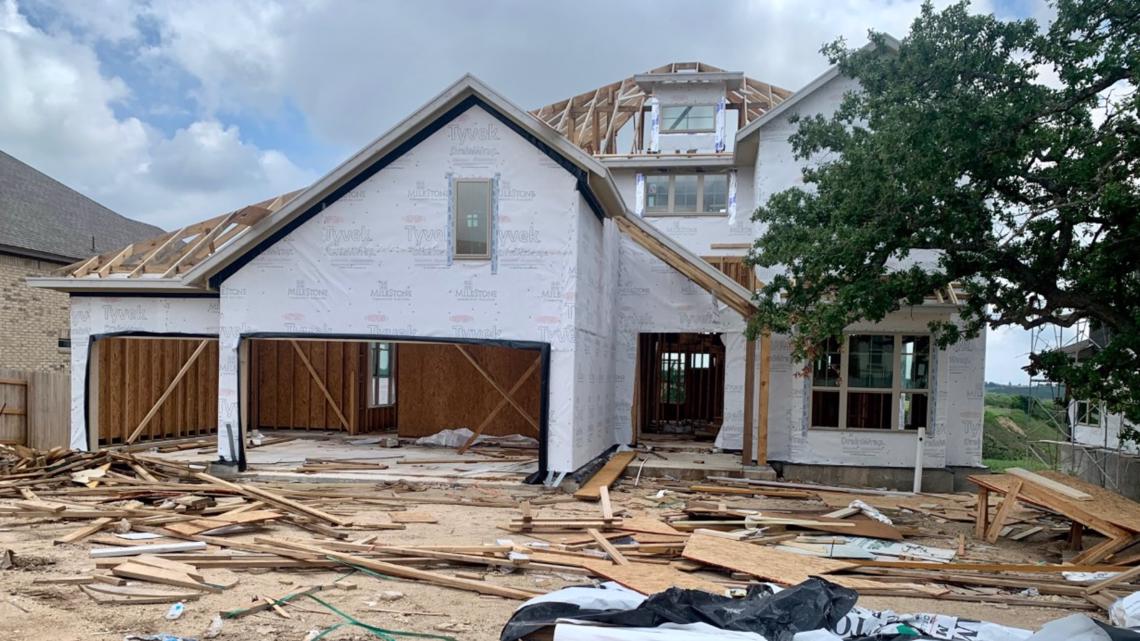
The Home Builders Association of Greater Austin explains why escalation and termination clauses are being used more.
AUSTIN, Texas — Buying a newly built home in Austin’s hot housing market can be a challenge. Labor and material shortages, demand for housing and COVID-19 all play a role.
Several homebuyers told the KVUE Defenders they’ve experienced extended delays, were told they had to pay more than the original price and some have even dealt with canceled contracts.
They blame the builders. But those in the home building industry say, “not so fast.” They said there are reasons why, now more than ever, builders are using contract clauses to protect themselves.
The number of new homes that received permitting and are under construction so far this year is 11,165. That’s according to the Texas Real Estate Center at Texas A&M University analyzing data from the U.S. Census Bureau. Research economist, Adam Perdue, said the Austin metro area is adding newly built homes to the market faster than bigger markets like Dallas or Houston.
But the new home construction boom hasn’t benefited all homebuyers, including Jasmine Javadi.
Dream homes turn into a nightmare of unexpected costs for some homebuyers
Finally finding her dream home was emotional.
“I cried the day we signed that contract,” Javadi said.
Javadi’s perfect home was set to be built on a lot in the Seven Oaks community in Westlake in West Austin.
In November 2021, Javadi signed a contract with Drees Custom Homes for $1.2 million.
“We knew that this home, this design, was the home that we wanted,” Javadi said.
But two months later, Javadi discovered just how much that dream would cost her — emotionally and financially.
Between January 2022 and the end of March, Javadi said the builder hit her with several price increases. The first was for $40,000. The second was between $90,000 and $100,000. Javadi said the third increase was an adjustment to the $100,000 hike.
“… $140,000 for [an] increase in lumber and other building materials and slab,” Javadi said.
The fourth increase was also an adjustment, from $140,000 to $192,000.
“Their reason was that the base price of the home had gone up, which boggles my mind,” Javadi said.
She wanted to know how the base cost of her home shot up in 10 days. She asked for an in-person meeting. And after 40 minutes, her contract was canceled.
“I was crying like, ‘I’m going to cry now because this is something that you work towards, right?'” Javadi said.
In Leander, Steffanie Hamilton addressed some of the problems she’s trying to get fixed in her newly built home.
From a concrete slab to a new build home in Leander
“I’m going to press that. You’ll notice that you will not hear anything,” Hamilton said of her non-working doorbell.
After waiting 15 months to move in, the mother of six can’t believe her newly built house has issues, including no hot water in the primary bathroom and a lock on the primary bedroom door that doesn’t work.
But Hamilton’s house problems started even before moving in.
A couple of weeks before closing in March, she said Milestone Community Builders asked for an extra $33,500. The new total is more than $660,000.
If she didn’t pay, Hamilton would have lost her earnest money with her home.
“I remember breaking down that day. I was like, ‘You know what? We’re just going to be out $20,000. They’re going to have it. They’re going to be able to sell my home that I’ve invested in, and they’re going to be able to sell it for hundreds of thousands of dollars more. And it’s all at my cost.’ It was very frustrating,” Hamilton said.
On top of that, Hamilton said Milestone wouldn’t provide an itemized list of what exact costs went up.
KVUE reached out to Drees Custom Homes and Milestone Community Builders for a response. A spokesperson for Drees sent the following:
“The home building industry has experienced unprecedented demand along with supply chain issues, which has resulted in unforeseen material shortages, labor scarcity and cost volatility. Additionally, each build is subject to specific customer requests and structural changes, which can result in additional cost fluctuations.”
A spokesperson for Milestone also responded:
“We are disappointed to hear that our customer is distressed about the closing of her home. We feel strongly however that due to unprecedented market conditions causing extreme rises in costs, this was a fair deal for the homebuyer. Rather than outright cancel the contract like some of our competitors, we wanted her to enjoy the equity already accrued on her home which we are very confident far exceeded the amount we asked her to pay. At the time of her closing, a similar home in her neighborhood would have been priced approximately $250,000 higher than what she had to pay. The option was also presented for a full refund of earnest money which she declined to take. We look forward to an easing of supply constraints that will bring our market closer to normalcy and present an easier process for all of our customers.”
Both turned down requests for interviews.
It all comes down to the contract
So, the KVUE Defenders went to the Home Builders Association of Greater Austin for answers.
Scott Turner is the president.
“We’ve got a housing problem,” Turner said.
Turner also said homebuyers must realize what’s happening in the Austin area: builders can’t build homes fast enough and, at the same time, demand keeps skyrocketing.
The KVUE Defenders asked Turner about getting itemized lists when costs go up. He said it’s reasonable to ask builders for them, but if it’s not in the contract, they don’t have to.
“It does come down to the contract, and I think there are some practical sides too, you know, disclosing every penny you spent on framing or lumber if you think about the number of homes that a big company here in Austin, like Lennar, will build thousands of homes this year, to have to provide cost data on thousands of homes to anyone who asks, is not practical, right? And that’s also not in their contract, right, for those obvious reasons, they can’t provide that level of detail to every buyer,” Turner said.
Turner said homebuyers should be able to expect transparency and communication.
“But your buyer’s question was a fair one, right? Even if the builder was not willing to provide, you know, like here’s a receipt, at least the builder should have a dialogue about where those costs went, right?” Turner said.
As for those price increases, Turner said that’s why it’s important to read and understand the contract before you sign.
Especially now, when more builders are using escalation clauses.
“So, if a cost that goes into the home goes up, then the escalation clause says, ‘Hey, I have the right under my contract to pass that cost on to the buyer,'” Turner said.
He gave an example of what many builders are doing.
“They don’t say, ‘I’m going to contract for this price, and then we’re going to sell it for that.’ They say, ‘We’re going to name it at a certain time.’ I don’t know whether to say whether that’s fair or not, right? But frankly, it’s almost the only choice that they have, right?” Turner said.
The following is a general example of an escalation clause, as provided by the Texas Association of Builders:
“In the event that there is a price increase in these construction materials categories in excess of ___% from the average of similar materials purchased by Builder in the preceding 30-day period from the execution of this Contract, the excess charges will be passed through to Owner, resulting in an increase in the Total Contract Price. Builder will keep…
