
Lake Fenton — “If you use the word ‘kindly’ in an email, don’t ever do it again,” said Detective Trooper Specialist Kyle Bowen, who works in the Michigan State Police Intelligence Operations Division. “If you see the word ‘kindly’ in an email, that should be raising every red flag there is because for some reason, they use ‘kindly’ a lot in their emails.” Probably 80% of…phishing emails have ‘kindly’ in them somewhere.”
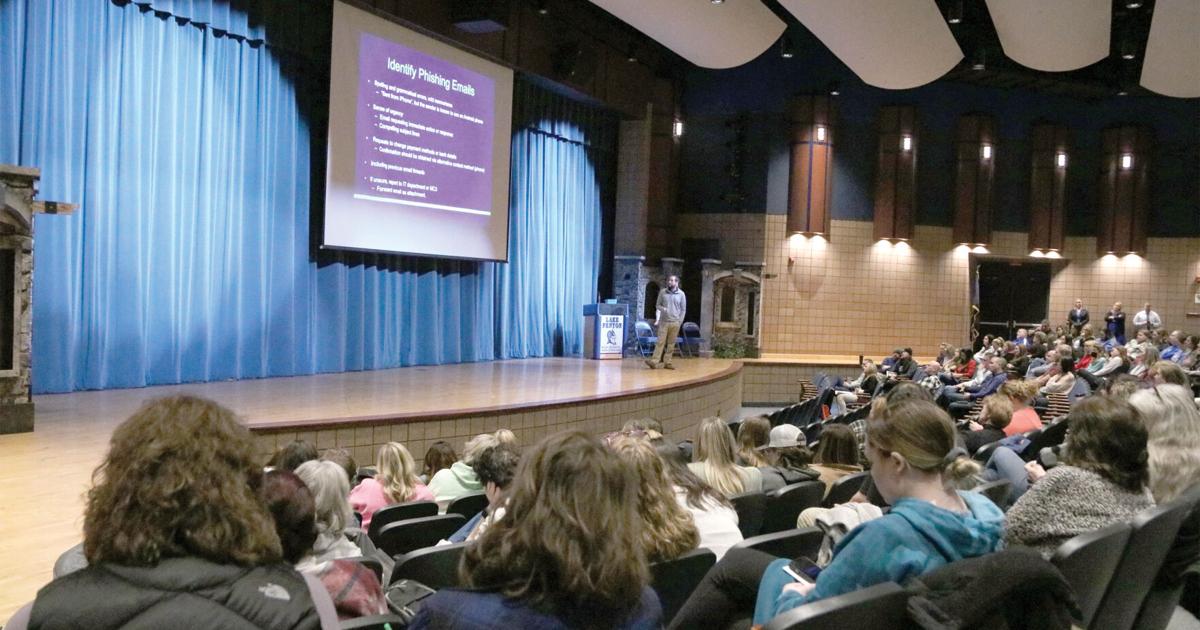
On Monday, Jan. 16, he gave a presentation to Lake Fenton staff in the high school auditorium about cyber security, scammers, how to detect phishing emails and more. Scammers often refer to people as “dear” in these emails and they commonly use the word “kindly.” He shared information and tips like this to help Lake Fenton Community Schools avoid cyber security threats.
“The threats we see today are ransomware incidents, business email compromises, and there’s other types of malware like payroll scams and the gift card scams,” he said. “The main goal of all this is to basically steal your money and these are coming from fraudsters who are overseas in countries like Russia, Nigeria, India, countries that don’t have any form of law enforcement agreement with the U.S. so we can’t touch them. That’s why we partner with Homeland Security or the FBI. In some cases, they can go out there and get them.”
Ransomware involves an attack where scammers encrypt an organization’s data and demand payment, usually in cryptocurrency, to restore access. The five most targeted industries are real estate, construction, government, insurance and finance.
Bowen said this extortion is the “biggest threat” they’re dealing with right now.
Phishing is when scammers use fraudulent solicitation in emails or on a website to illegally gain data or money from people. Bad actors often gain access to a network through company email accounts. If they’re successful in compromising one employee’s email, they will impersonate that identity to fool others. Scammers, for example, could send emails to the company’s human resources department to request that an employee’s direct depository bank account be changed.
“They like to identify upcoming financial transactions and jump in between them to send money to their bank instead of where it’s supposed to go,” he said.
They will often impersonate a company executive and ask their employee to purchase gift cards and send them photos of the gift cards. Bowen showed real life examples of successful phishing emails that scammed people out of thousands of dollars. Bowen recommended limiting employee information published on websites.
One in 20 users click on phishing emails, which is why it’s a common method used by scammers. Approximately 25% of link clicks happen within 10 minutes, 50% happen within the first hour and 90% occur within the first 24 hours. These messages also contain a sense of urgency and request “immediate action.”
When spotting phishing emails, look for spelling and grammatical errors in names and emails. Also look for odd mannerisms. If their signature looks weird, don’t trust it. Don’t call the phone numbers in these emails. Google the phone number for these institutions instead. Hover the mouse over links to see a preview. If it’s suspicious, don’t click on it. Bowen told LFHS staff to report these emails to the IT department or Michigan Cyber Command Center (MC3).
“It only takes one person to open this document and it could affect the entire school,” he said.
Virustotal.com will tell users if a link or attachments is malicious or clean.
Scammers can also create convincing websites that look identical to the Lake Fenton Community Schools website and send emails to parents requesting donations for a fake school event.
Bowen said strong passwords have a minimum of 15 characters. The longer, the better. They should contain a mix of random uppercase and lowercase letters, as well as numbers and special characters. Passwords should never be reused or shared and they should be regularly changed.
He recommended always using multi factor authentication and using a password manager, which is a tool he uses.
This technique is when criminals have someone’s email account or password and extort them into sending them money. Bowen said in one case, scammers email someone and say the malware on their device allowed them access to their display scene and camera. They threaten to expose what porn someone was watching and recorded video clips of said person unless they pay.
“They’ve been able to track this wallet and it’s received over 40 million dollars,” he said.
People can contact the Michigan Cyber Command Center (MC3) at mc3@michigan.gov or 1-877-MI-CYBER or report an incident to the FBI’s internet Crime Complaint Center at www.ic3.gov.
