
A new Congress leader may make an electoral impact by his very presence.
Congress voters who had moved away from the party, after being influenced by the
BJP’s ‘family rule’ campaign, can now return with a certain moral satisfaction
BY N SATHIYA MOORTHY
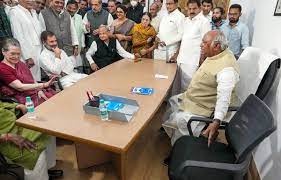
The expressions on the faces of Rahul Gandhi and other senior party leaders at this interaction between incumbent and
predecessor truly makes for a Kodak Moment. Photograph: Manvender Vashist Lav/PTI Photo
Now that the Congress party has elected a ‘non-family’ leader as president after two decades, is the Centre’s cancellation of
an FCRA (Foreign Contribution (Regulation) Act) licence for two NGOs headed by outgoing acting party chief Sonia Gandhi,
indicative of an unfamiliar nervousness in the ruling Bharatiya Janata Party camp after Narendra Modi became prime minister
in 2014?
The answer is a qualified yes-and-no. The way the BJP, starting with the prime minister and going all the way down to the
faceless social media activists, have been going after the Nehru-Gandhi family since before the 2014 elections, and keeping
them in focus even after the Congress has shown no signs of an early revival to challenge ruling party through the past years,
it looks as if they are either nervous — or, are on a mission to cause a ‘family mukt Congress’ and a ‘Congress mukt Bharat’,
which alone has been on their agenda through the past decade and more.
There is no denying the success of the Modi juggernaut against the Congress by keeping the Nehru-Gandhi family in sharp
focus. It is in contrast to the earlier Vajpayee-Advani campaign that focussed on the ‘foreigner’s issue’, centred on Sonia
Gandhi. It did not sell in elections 2004, when the ruling BJP-NDA lost to Sonia Gandhi’s slogan ‘Aam Aadmi’. Modi’s ‘Achche
Din’ did the trick in 2014.
For all the massive victories that the BJP has scored since, Modi’s campaign in 2014 focussed on unsubstantiated
allegations of corruption against Congress-led UPA-II government of two-term prime minister Manmohan Singh.
The 2-G scam, where the CBI finally put the graft money way below the ‘presumptive loss’ of Rs 1.76 lakh crores, as
claimed by then comptroller and auditor general Vinod Rai, and the Commonwealth Games construction scam, which became
a national humiliation in Delhi, all did in the Congress-UPA, in elections 2014.
That the 2-G allegations did not stick before the trial court draws back memories to the media-driven BJP-NDA campaign
against then Congress prime minister P V Narasimha Rao in the ‘Lakhubhai Pathak corruption scandal’, where again the court
cleared PVN of wrongdoing, long after the ruling party had lost the post-reforms polls of 1996.
It is another matter that in the post-demolition Ayodhya situation, which witnessed violence and terror attacks, neither could
the BJP make it. The nation wanted a non-Congress, anti-BJP government, and got one, even if it was a post-poll khichri
formation, under the Janata Dal’s H D Deve Gowda, followed by I K Gujral.
The BJP-NDA swept back to power in 1998 and 1999, with the slogan ‘Give us a chance’, after the 13-day fiasco in 1996.
On the right is K C Venugopal, arguably the most powerful among the Congress general secretaries. Photograph:
Manvender Vashist Lav/PTI Photo
If the question is whether Mallikarjun Kharge’s elevation as Congress president, with unhidden yet unmentioned blessings
from the ‘first family’, will help the party’s sagging/non-existent morale and chances in the Lok Sabha polls of 2024, the answer
should be a qualified ‘No’.
At 80, Kharge does not inspire the younger generation of voters, especially in states where the party is next to non-existent –
– which is covering most of the states and most seats in the 542-member Lok Sabha.
His performance as Union minister under Manmohan Singh earlier and as Leader of the Opposition in the Rajya Sabha does
not inspire confidence in the party cadres that his election alone could do the trick.
Not that his defeated younger competitor, Shashi Tharoor, would have made a difference outside of elite urban
constituencies, where he suffers from a mixed reputation preceding his arrival — thanks to the hard work put in by the uncanny
social media sleuths of the BJP rival.
Both Kharge and Tharoor lack Modi’s charisma just now, not that Sonia, Priyanka and Rahul Gandhi together can make a
difference. But at 66, Tharoor may have had his usefulness for marketing the party among overseas Indians and also
foreigners, including government representatives.
The octogenarian has also replaced an ageing Congress Working Committee with an equally ageing steering committee
with a higher number — 47 — of members. With due respect to his erudition, efficiency and contributions, Manmohan Singh
does not fit in in any role to revive the age-old party. A K Antony, 81, who wound up his Delhi establishment for retirement in
Kerala, is there in Kharge’s list.
It is not about age nor their contributions to the party in the past, but how active they are able to campaign for the party —
and in what role.
Maybe, the Modi-Shah duo in the rival BJP has had no use for the Margdarshak Mandal that they created after taking over,
but that kind of an outfit of veterans may still have use in a sagging party as the Congress, especially when drafting the
election manifesto — and checking on the incumbent leadership from running away with ideas and promises that make a
mockery of the system.
Kharge is lucky. A group of oldies who refused to make space for the younger generation, even if of their own choice, has
left, citing ‘lack of internal democracy’ as the reason. Ghulam Nabi Azad belongs there. For reasons right and wrong,
Kharge has kept out Shashi Tharoor, his defeated competition. Not certainly out of spite, one should assume. Tharoor’s
inclusion could have helped credibility, but he is also wrecking credibility from within.
His camp had questioned transparency in the party president’s poll and in did so public. Tharoor is also considered a
maverick and a loose cannon, whose course is unpredictable and can be hugely embarrassing.
The party can leave much, if not all of it, behind.
But where a new leader for the Congress in the current situation may make an electoral impact is by his very presence. Old-
time Congress voters, independent of age, who had moved away from the Grand Old Party, after having been influenced by
the BJP’s ‘family rule’ campaign from the past, if they want to return, now they can do so with a certain sense of moral
satisfaction, if any.
Then there are those who have been watching from the wings, the Modi-Shah monopoly of the BJP over the past nearly a
decade, and draw parallels with the ‘family rule’ in the Congress. Though the BJP faced a similar situation even under the
Vajpayee-Advani duo, there was no dearth of second-line leaders in the party who could speak their mind, both within the party
and outside.
Today, Nitin Gadkari is the only mainline leader and senior Cabinet minister who does it, but in very many obtuse ways. The
BJP’s maverick leader Subramanian Swamy is the other, but he is not getting enough media space, which is required to reach
out to the party cadres and the voters alike.
Through social media posts, Swamy has been riling the Modi government over the prime minister’s continued reluctance to
name China as the aggressor in Galwan-2020. This has not gone down well with Modi’s ‘nationalist constituency’ that goes
beyond the BJP’s cadres and parent RSS’s ideological backers.
A ‘giant-killer’ in his own way, Swamy is now talking about moving the higher judiciary on the ‘Pegasus issue’ through a PIL,
but after consulting other ‘stake-holders’ (!)
The BJP-RSS clan may have problems with the Modi-Shah duo’s style of functioning, but for the Sangh Parivar to continue
in power, they need Modi more than the other way round.
It is not as if without Modi or Shah at the helm, the Congress in particular and the otherwise divided Opposition in general
can hope to defeat the BJP-NDA any time soon, but with Modi at the helm, the BJP would put the Opposition on the defensive,
all over again.
From the Congress’s stand-point, will Rahul Gandhi’s Bharat Joda Yatra help revive the cadre-morale, if not voter-return? If
that were to happen, then how would critics, especially from the BJP’s social media, react — and re-energise their multi-
pronged attacks on the ‘family’?
Or, will government agencies go after them again and again, and also against other Congress leaders, whether or not it
includes the likes of Kharge himself?
Already, a section of the urban middle class seems to have developed a bad taste in the mouth for the kind of ‘raid raj’ that
the BJP runs from the Centre, where no raid, arrest or seizure has been followed up to the trial stage even after years — thus
proving the unproven claims to innocence by the Opposition leaders, from different parties, thus targeted.
Whatever the legal consequences of such raids and arrests, experience has shown how the joy of ‘over-kill’ for the ruling
party cadres has the potential to upturn the over-anxious voter’s re-discovered concerns for democratic proprieties,
constitutional rights and political morality.
It happened with the revival of Indira Gandhi’s sagging political fortunes, post-1977 when the divided Janata Party
government at the Centre went after her without evidence, with the result, a remand court in Delhi ‘discharged’ her without she
having to apply for bail, when arrested.
For now, the RSS has said that Ayodhya has lost the charm for BJP voters. Truth be told, Ayodhya even from the demolition
days of 1992 did not help the BJP in elections. If anything, the post-demolition, the Opposition SP-BSP combine swept the
assembly polls in Uttar Pradesh, a year later in November 1993. But the RSS seems to imply that all Hindutva issues have lost
their purchasing power.
The revival…
