

And bringing a flood of forced organ harvesting and phone scams
COVID-19 has been an unmitigated disaster for humanity. Millions have died. Hundreds of millions more have been impoverished.
Less well-known is that the poverty and desperation caused by COVID-19 are fuelling a transnational network of scammers, human traffickers, and organ harvesters in Southeast Asia.
It’s a veritable bull market for the industries trading in human misery.
The deplorable conditions that victims must endure are heartbreaking. The exact number of victims is unknown, but it could be in the tens of thousands.
Furthermore, the tendrils of these scam operations spread far and wide, bringing even more misery to their victims around the world.
This article examines how poorly-governed parts of Southeast Asia have devolved into a veritable “scam archipelago,” as The Diplomat puts it.
Because it is only with widespread awareness that there can be any hope for action.
Sihanoukville, formerly known as Kampong Som, is located on a long promontory facing the Gulf of Thailand. With its rolling hills and unbroken beaches, it looks like a postcard-perfect destination for tourists and pleasure-seekers.
Yet despite this favourable topography, Sihanoukville’s history is short, having been developed only recently.
In the 1950s, a French-Canadian construction team financed by French and American capital identified Kampong Som as ideal for Cambodia’s first deepwater port.
Construction took five years. When it was finished, Kampong Som was renamed Sihanoukville in honour of King Norodom Sihanouk.
To attract investment for further development, the Cambodian government approved the establishment of the Sihanoukville Special Economic Zone (SSEZ) in 2006.
Private investment began to flow in from Cambodian firms and, crucially, China, whose rising wealth enabled private businesses to look beyond their home country for additional growth.
The prospect of billions of dollars in Chinese investment flowing into their borders did not escape the attention of regional governments.
In 2007, Laos established the Golden Triangle Special Economic Zone (GTSEZ) in an infamous region once known for housing the world’s most extensive heroin trafficking operations.

Meanwhile, Chinese investors established the Shwe Kokko New City project in Myanmar, signing agreements with a local armed group to construct an unofficial Special Economic Zone near the Myanmar-Thai border.
The influx of significant private capital into areas nominally controlled by central governments but with little control over the periphery is a volatile combination.
Without strict governmental oversight and with the connivance of local government officials who can be monetarily persuaded to look the other way, these special economic zones became hotbeds for all sorts of trade, legal or otherwise.
However, the election of Xi Jinping as the Chinese president in 2012 tipped the balance in Sihanoukville and other SEZs in the region decisively in the direction of lawlessness.
Upon assuming the role of President of the People’s Republic of China, Xi Jinping launched an unprecedented anti-corruption campaign.
This all-encompassing sweep against businessmen and officials suspected of profiting from graft in the preceding three decades of rapid economic growth ensnared an ever-expanding circle of “tigers and flies”, people with ranks elevated or mundane.
In this aggressive campaign, the Chinese government focused on Macau, the Special Administrative Region that China reclaimed from Portugal in 1999.
Macau is renowned for its thriving casino industry, earning it the moniker “the Las Vegas of the East.”
(As an aside, Macau’s casinos generate more gaming revenue than the entire state of Nevada. Maybe Las Vegas should be the “Macau of the West!”)
Before Xi Jinping’s corruption crackdown, most of Macau’s gaming revenues came from VIP gamblers, assisted by junket operators who would bring them, and their money, into Macau, safely away from the prying eyes of the mainland government.
But with the zeal with which the Xi administration has pursued its anti-corruption campaign, it was only a matter of time before the government put pressure on junket operators to stop making it easy for untraced money to leave the mainland.
Lacking income, junket operators — many of whom have triad connections — began looking for opportunities elsewhere. And it discovered a plethora of opportunities in Sihanoukville and other SEZs nearer to the Chinese border.
As the cash poured in, Sihanoukville, initially a sleepy beach resort popular with backpackers, began attracting shady casino operators eager to provide a new location for Chinese gamblers to indulge in their favourite vice.
As more casinos sprang up, so did businesses trading in other vices, such as traders in products made from endangered species or sex with minors.
In its heyday, Sihanoukville and the other regional SEZs were less Las Vegas, more Star Wars’ Tatooine — a haven for the galaxy’s undesirables to mingle and do business.
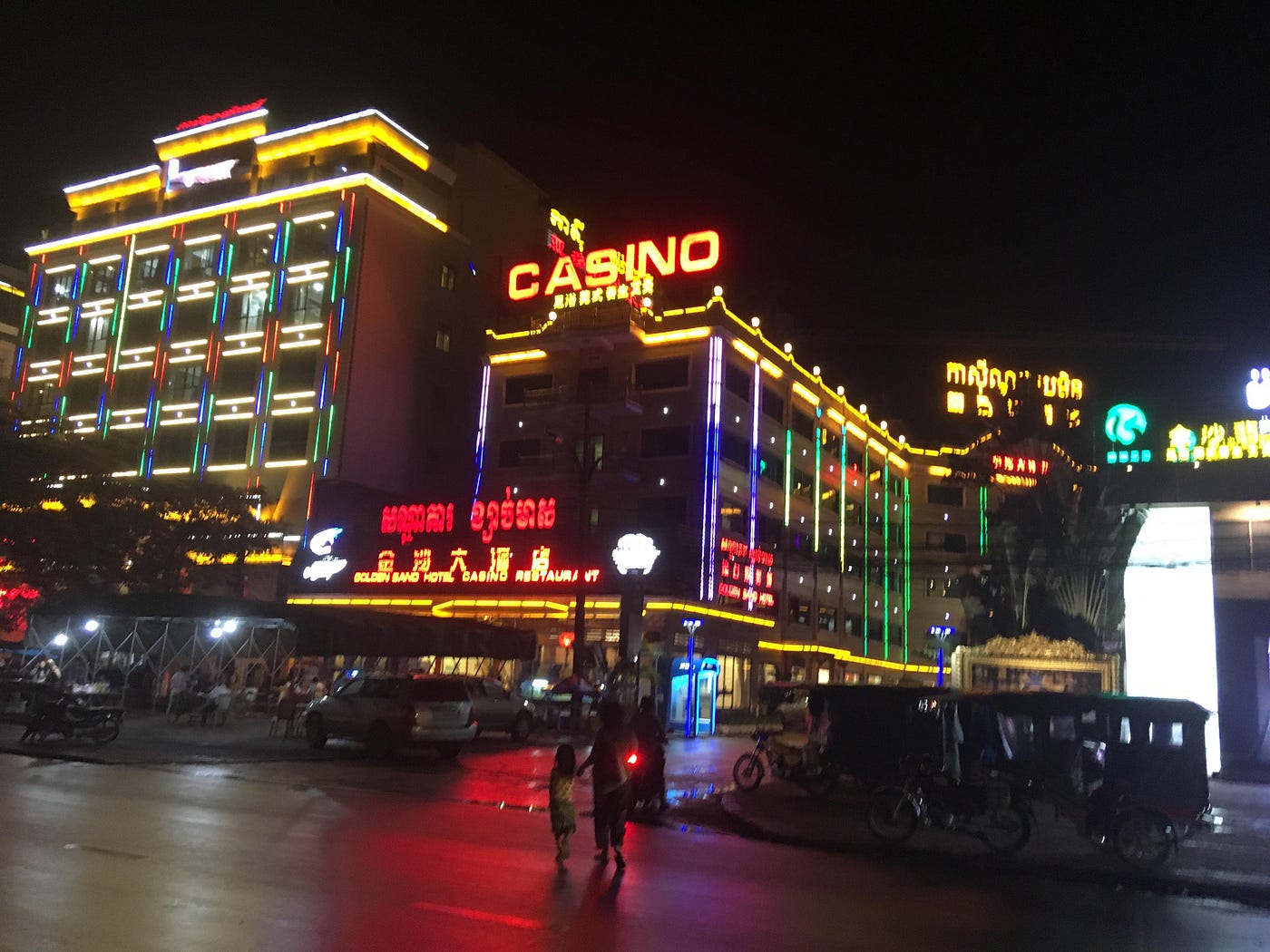
COVID-19 would change all of that.
The intensity of the global response to COVID-19 put an abrupt halt to activities in Southeast Asia’s free-wheeling SEZs. The hundreds of casinos throughout the region remained silent as governments imposed strict quarantine measures to combat the COVID-19 break.
Crucially, China’s severe “zero COVID” policy cut off the flow of mainland Chinese punters who had sustained the gambling industry. Without the consistent flow of punters warming seats in the casinos, the region’s criminal elements were forced to find alternative income sources.
Phone scamming provided them with a lucrative growth opportunity.
The outbreak has been confusing for everyone. People worldwide were perplexed by rapidly changing policies, sudden shifts towards e-payments, and the mandatory use of public health surveillance apps, just to name a few.
The abrupt shift towards technology has been a godsend for scammers, who exploit the confusion to trick people into downloading questionable apps and inadvertently disclosing personal information.
These scammers have found the Chinese diaspora community an especially appealing target.
The overseas Chinese community numbers nearly 60 million people who live all over the world. Notably, many overseas Chinese live in wealthy countries such as the United States, Singapore, or Canada, maintaining linguistic and cultural ties to their ancestral homeland, making them a gold mine for Chinese-speaking scammers.
COVID-19 also wreaked havoc on the economies of Southeast Asia, which is home to roughly 70% of the overseas Chinese population. Without access to a ready supply of workers from the Chinese mainland, scam operations found a ready supply of Chinese-speaking workers from Southeast Asia.
Thus, they placed realistic-looking advertisements to entice young and semi-skilled workers from Thailand, Malaysia, Indonesia, Vietnam, the Philippines, and Taiwan, promising them lucrative jobs in online gambling operations paying up to US$3,000–4,000 per month.
These ads promise food, lodging, and transportation, making it difficult for these victims to refuse, especially since they mostly live in countries where the minimum wage is 10% to 20% of what is being offered.
However, once they arrive at their destination, the precarity of their situation becomes clear to them. Once they’ve cleared customs, the local agent seizes their passports, bundles them into a van, and blindfolds them, rendering them helpless to contemplate their fate.
The reality these poor victims face is bleak.
In February this year, a Chinese man made the sensational claim that he had been kidnapped in China and trafficked to Sihanoukville, where he was held as a “blood slave.”
He claimed that after refusing to participate in scam operations, he was transferred to another facility where they chained him up and extracted his blood every month.
When he finally escaped, he had to be rushed to the hospital because so much blood had been taken from him that he experienced multiple organ failures.
A Thai woman claimed in March 2022 that she was beaten and tortured for refusing to work for call centre scammers after being lured to Sihanoukville. She tried to flee, failed, and was forced into being a blood slave.
According to her, once the gang could no longer draw blood from her, they threatened to remove her organs for sale.
The Cambodian and Thai authorities have denied both claims. Nevertheless, the sheer volume of stories emerging from alleged former victims is difficult to ignore.
More startlingly, an Al-Jazeera investigation revealed links between the scam gangs and well-connected Cambodian tycoons and businessmen.
Some of these individuals can further be linked with Cambodian Prime Minister Hun Sen, the former Khmer Rouge commander who has ruled Cambodia with an iron fist for nearly four decades.
These claims are unlikely ever to be proven definitely. But, in Southeast Asia, where press freedom is elusive, it’s safe to say that the truth about the situation in Cambodia cannot be established with crystal-clear certainty.
Nonetheless, it’s notable how severe this problem has become that the Chinese and Taiwanese authorities are consistently communicating with one another to assist their citizens, despite the escalating tensions between the two countries.
The media is reporting on Cambodian scam operations with increasing frequency. Cambodia holds the rotating chairmanship of the ASEAN regional grouping this year, making allegations of widespread human trafficking within its borders all the more troubling.
Cambodia isn’t alone in hosting scam operations and human traffickers. Scam operations are also…
