
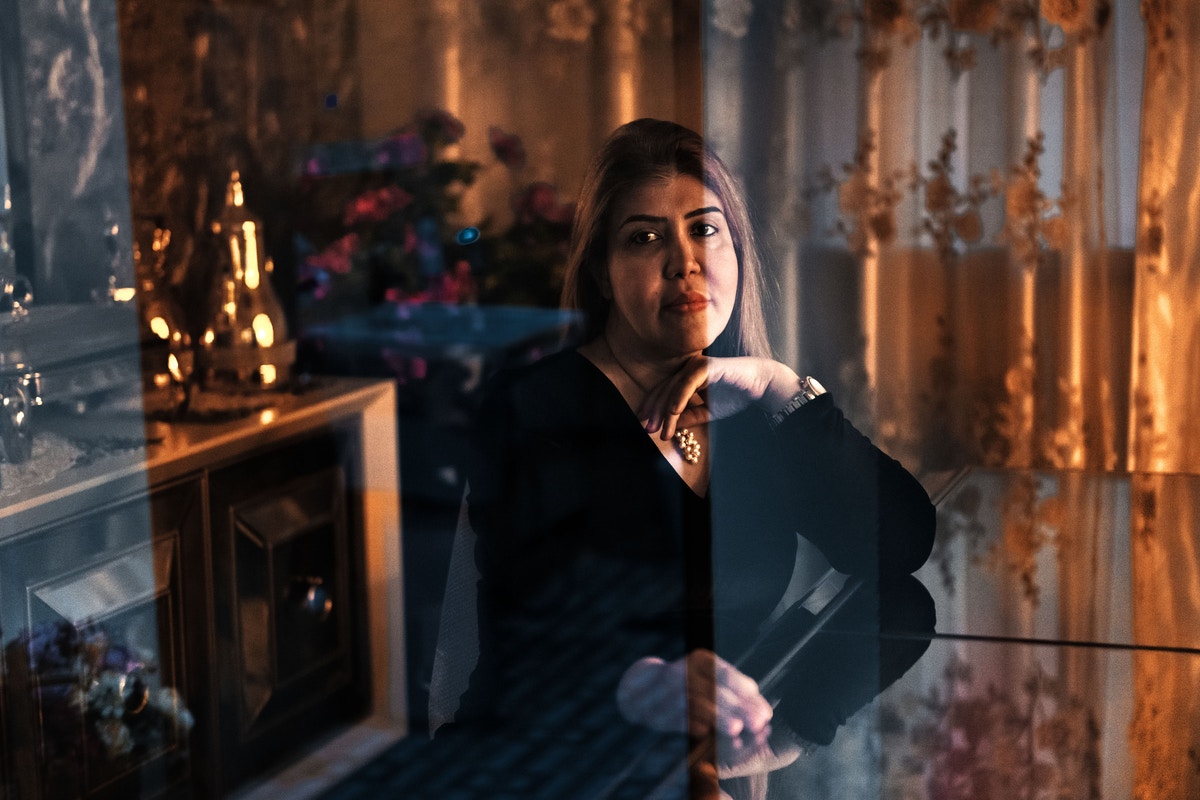
They gave her a metal spoon. It was the first mistake her guards made. It would prove to be just enough to set her free.
For more than 40 days, Sara Miran had been held hostage by an Iranian-backed militia that operated with almost total impunity in post-Saddam Iraq. Miran, a real estate developer who lived in Virginia, was kidnapped while she was working in Iraq in September 2014. She was imprisoned in a locked, third-floor room of a house in a Baghdad neighborhood that served as one of the militia’s strongholds. The room had wood paneling and a marble floor; this had once been an elegant home, transformed into the militia’s prison.
Miran was certain the militia was going to kill her. Her captors forced her to wear a prison uniform, like the clothes the Islamic State group made its hostages wear just before they were executed. They had whipped her for five straight days with wire cables, trying to make her falsely confess to being a CIA spy. Her guards never showed their faces, and when she asked why, one of them said they would reveal themselves when she was about to be released. “Once I heard him say that, I knew they were going to kill me,” Miran told The Intercept. She knew they would never let her go if she could identify them.
She was desperate to escape. There were at least two guards in the house at all times, and they searched her room each day to make certain that she wasn’t plotting a breakout. They installed a surveillance camera in the room so they could monitor her movements 24 hours a day, watching even while she slept on a mattress on the floor.
Her captors fed her the bare minimum to keep her alive — a half piece of bread, some cheese, tea, a little soup — and she lost 30 pounds. With each meal, they brought her plastic spoons. But on a Sunday in October, her guards altered their routine. Instead of bread and cheese, they brought her a lunch of rice and curry. And along with the new meal came a metal spoon.
Miran hid the spoon in the tank of the toilet in the bathroom adjoining her room. Then she waited for the night.
At 9 p.m., she went into the bathroom and got the spoon. With years of experience as a manager of construction projects, she knew the weak points in building designs, and so she used the spoon to dig into the edges of the wall surrounding the small bathroom window. It took her 15 minutes to remove the frame and the window without breaking the glass. She said a silent prayer of thanks that the guards had not heard the noise she had made.
She went to her room’s closet and put on the clothes she had been wearing when she had been kidnapped, which her captors had incongruously left with her. She then put on her maroon prison uniform, topped with a hijab, so she wouldn’t rip her own clothes while escaping. Back in the bathroom, she leaned a chair against the wall and looked out the window. She was three stories aboveground, on the back side of the house. At 10 p.m., she squeezed through the window, grabbed onto a drain pipe anchored to the side of the house, and began to climb down. There was no turning back.

Left/Top: Sara Miran’s side table containing beauty products, a jewelry box, and three handguns belonging to her, her husband, and her security guard. Right/Bottom: A view from Sara Miran’s apartment complex in the Green Zone in Baghdad, Iraq, in 2022. Photos: Emily Garthwaite for The Intercept
Sara Miran’s story is the remarkable answer to what seemed for years to be an unsolvable human mystery, one that was buried deep in an archive of secret Iranian documents that were leaked to The Intercept.
When The Intercept published a series of stories in 2019 based on an archive of hundreds of leaked Iranian intelligence cables detailing how Iraq had fallen under the sway of Iran, one document contained what appeared to be a fragmentary clue to an untold story. The document was a report of a 2014 meeting between an Iraqi official and the Iranian consul in the southern Iraqi city of Basra.
“The subject of the meeting was Ms. Sara,” stated the cable, which was written by an Iranian intelligence officer and sent to Iranian intelligence headquarters in Tehran. The Iraqi official told the Iranian counsel that he was relaying a message from officials in Kurdistan, the semi-autonomous region in northern Iraq. The Kurdish officials wanted to get a message to Maj. Gen. Qassim Suleimani, the powerful head of Iran’s Quds Force — the secretive intelligence and special operations arm of the Islamic Revolutionary Guard Corps that dominated Iraq — to release “Sara,” a woman who had apparently been kidnapped in Basra.
After the meeting, the Iranian consul gathered the intelligence officers who worked in his consulate. He wanted to know from them what was really going on. Why did the Kurds care so much about this woman named Sara? Why did they want to get a message to Suleimani about her? Above all, he wanted to know the answer to this simple question: What do we know about Sara?
The intelligence cable did not include the answers. It didn’t even include Sara’s last name, or her nationality. And so the mystery of “Sara” lingered, long after The Intercept published other stories based on the Iranian documents.
It took time to unlock the story. Clues in the archive of leaked cables helped, but ultimately it came down to old-fashioned reporting, phone calls during the Covid-19 pandemic to a wide variety of people in Basra, Baghdad, and Kurdistan, which finally led to a name: Sara Miran. Another round of reporting led to Miran herself, and to extensive interviews with her and members of her family, along with business associates, government officials, and others familiar with the case. Key elements of her story were also confirmed by documents subsequently obtained by The Intercept.
Once unearthed, Sara Miran’s story turned out to be a remarkable tale of an ambitious Kurdish American businesswoman whose kidnapping, and her efforts to escape and survive, ultimately led to a nighttime battle through the streets of Baghdad between the heavily armed Iranian-backed militia that kidnapped her and the Iraqi federal police and the Iraqi presidential guard force seeking to rescue her. It was a running gunfight, evocative of an action movie, involving hundreds of combatants from opposite ends of Iraq’s sectarian divide, all battling over a woman who lived in an American suburb.
On a human level, Miran’s story is an anatomy of a kidnapping, an underreported scourge on unstable countries like Iraq. Thousands of Iraqis and foreigners living and working in the country have been kidnapping victims since the U.S. invasion in 2003, many disappearing without a trace even after ransoms have been paid. Most kidnappings in Iraq are conducted by militias and criminal gangs for money, but Miran’s kidnapping was one of the unusual cases that had both political and financial overtones. Miran is also one of the few high-profile kidnapping victims in Iraq to escape, survive, and tell her story.
“My kidnapping is something that has happened to many other people,” she told The Intercept. “Many of them were killed, and others can’t speak about what happened to them because of fear. They have killed many, many other people, and they remove their bodies and threaten their families if they talk about it. I believe that God was on my side.”
Photo: Emily Garthwaite for The Intercept
Sara Hameed Miran was born in 1977 into a politically connected family in Sulaymaniyah, in the Kurdish region of northern Iraq.
Her family’s wealth and influence couldn’t protect her from the bitter combat that raged almost nonstop during her childhood. Wars blurred together. There was the Iran-Iraq war, the Kurdish insurgency against the regime of Saddam Hussein, the Kurdish civil war between two powerful Kurdish factions, and the American wars against Iraq. “I was born into bombs and guns,” she says. Her experience with war hardened her in ways that she now believes helped her stand up to threats and survive her kidnapping. During an extensive series of interviews for this story, she matter-of-factly described in graphic detail the most intense episodes of her life and of her kidnapping ordeal.
One of her earliest memories is of watching a gunfight on the street that spilled into the driveway of her family’s home; she was only 3 or 4, and she’s not sure who the combatants were. When she was older, she saw how the Peshmerga, the Kurdish militia, would slip into Sulaymaniyah from the surrounding mountains at night to attack Saddam’s army; rocket fire would force Miran and her family to hide under the stairwell in their house. “Every month or two, my father would have to replace the windows on our house, because there were no windows left,” she recalls. By the time she was 14, she was able to handle an AK-47.
After Saddam’s grip on Kurdistan was weakened by his defeat in the 1991 Gulf War with America, the major Kurdish factions agreed to hold elections for a new Kurdish parliament, and Miran’s father was elected. She moved with the rest of her family to Erbil, the Kurdish regional capital, where her father took his seat in parliament. Her family maintained its real estate holdings and other business interests in Sulaymaniyah.
Miran finished high school and fell in love with Gring Marif, a neighbor. Their proposed wedding led to tensions with her parents, because she came from a much more prominent family. But she insisted, and they were married in 1998 and had two sons and a daughter. While it was an unhappy marriage, it would eventually bring Miran and her children to America.
In 2003, Miran graduated from Salahaddin University, where she studied engineering. That year, the United States invaded Iraq, and her husband went to work for the U.S. military as a translator, and later for the…
