
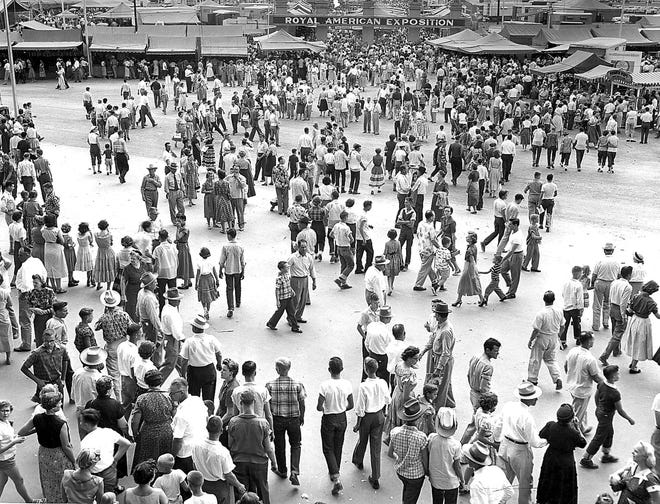
The skies stayed clear, temperatures kept to the low 90s, and record crowds were visiting the 1952 State Fair of Oklahoma knowing it wouldn’t be at its historic home much longer.
Promoters bragged the fair easily hit its goal of 400,000 visitors after reporting a disappointing drop in attendance the year before. A few years later, the State Fairgrounds was to move from Eastern Avenue and NE 10 to a brand new futuristic complex at NW 10 and May Avenue. The city was growing and the state fair needed more room to grow with it.
Southern Homes, a Texas company, set up a tent next to the popcorn stand and offered the state fair visitors a deal they couldn’t ignore.
“Buy land” the promoters urged.
Houghton Heights was outside of city limits so there would be no taxes. The promoters also bragged about the “beautiful” location of the future neighborhood at Memorial Road and Western Avenue with “elevated” views.
After advertising Houghton Heights lot sales for much of 1952, Southern Homes tempted fairgoers with a chance to buy lots at between $300 and $600 with down payments as little as $10.
They had 640 lots for sale on the 160 acres. Some lots were offered free of charge if fairgoers agreed to pay for the “paperwork.”
The land was undeveloped, but promoters promised roads, sewer and water utilities were all in the works. More lots were moved through a radio promotion, and more than 400 lots were sold.
Promises were not kept. The land went undeveloped for decades and ended up in litigation throughout the 1980s and much of the 1990s.
More:Abandoned ranch near Chisholm Creek to be cleared to make way for mixed-use development
The tale of Houghton Heights continued to take strange twists and turns well into the new century when finally, in 2014, a deal was struck between the two survivors of the yearslong legal battles, Raymond Hefner and Don Karchmer, and long-time real estate broker and investor Dan Ward.

That deal cleared the way for Chisholm Creek, an ambitious 190-acre mixed-use development that is far from complete but already home to apartments, restaurants, shops and attractions. The name Houghton Heights has faded though it still appears on some property records. Those involved can still recite specifics of the ordeal years later.
For Karchmer, Houghton Heights represented 30 years spent on a deal he never intended to pursue, a deal that ended up with a who’s who of the city’s business community, leadership and power brokers. Altogether, a group of disgruntled buyers who bought into the dream at that 1952 state fair sued 39 people.
“It was a joke,” Karchmer said. “You couldn’t find an attorney in town that wasn’t conflicted.”
John Michael Williams, a longtime municipal and property attorney, was among those on all sides who agreed Southern Homes pulled off a scam on hundreds of people.
“You had folks buying these lots that didn’t have any value at all,” Williams said. “It was like the Florida land scandals where they would work out a plat, put out a pretty picture and sell the lots to unsuspecting buyers who didn’t know what was going on. It was a classic scam in Florida in the 1920s. This was much later.”

Houghton Heights
The story didn’t start out this way.
Memorial Road was just coming into existence when Leonard Houghton took a risk in the mid-1940s and purchased 160 acres of prairie far outside of Oklahoma City limits. Houghton was the son of a prominent 89er and civic leader. He was 48 years old and for most of his adult life he had worked aside his father, Henry B. Houghton, who made his fortune in the Oklahoma City oilfield.
Leonard Houghton set up an office in the nearby town of Britton and started advertising residential lots for sale at the corner of Memorial Road and Western — “two and a half miles north of Britton.”

The timing was good with thousands of soldiers returning home from World War II eager to buy homes and start families. Oklahoma City was indeed set to grow north.
Houghton, however, didn’t live long enough to get the development started and in 1951 his estate sold Houghton Heights to the Southern Homes Co.
Leonard Houghton had the tract platted with 160 lots with land reserved for street easements. Southern Homes Co. took those 160 lots and divided them into 640 lots.
After selling about 400 lots at Houghton Heights, Southern Homes quit marketing the property and moved on.

Oklahoma City, meanwhile, was growing rapidly through a series of annexations. The city spanned 29 square miles when Houghton Heights was advertised as being “west of Britton.” By 1960, the surrounding area was taken into Oklahoma City as it grew to 216 square miles.
Being in an incorporated area did not bring city services to Houghton Heights. The aspiring homeowners were left on their own to learn their property was not properly platted. They were told at City Hall the promised utilities and roads would not happen unless they all joined together to pay for those improvements. And when they sought building permits, they were turned away.
More:An early look at several new restaurants likely to open in Oklahoma City in 2023
They were stuck with worthless land where even the mineral rights had been sold to different parties including Joseph P. Kennedy, patriarch of the powerful political dynasty that included John, Robert and Teddy Kennedy.
Years passed. Quail Creek, Camelot and other neighborhoods were popping up between Hefner and Memorial. State transportation officials started talking about long-term planning for an “outer loop” highway or turnpike that would go along Memorial Road.

‘This land isn’t that valuable’
Newcomb Cleveland, a land speculator and developer, was the first to see what was ahead for the area and attempt to straighten out the mess created at the state fair booth.
“He was actually a land man buying up oil rights,” Karchmer said. “He was working on this section of ground, saw the oil rights were owned by others and the land ownership was broken down to these 60 foot lots. And there were hundreds of them.”
And those hundreds wouldn’t be easy to track down as they were scattered over 35 states and living as far away as Mexico City. Some were dead. Some heirs didn’t know they owned the land. Others simply couldn’t be found.
Southern Homes bought the acreage from the Houghton estate for $40,000 and Cleveland reported the company had sold all but 205 of the 650 lots, meaning Southern Homes likely doubled to tripled its investment with the state fair booth and a radio contest held at the same time.
“The fairgrounds just isn’t the proper place to conduct real estate business,” Cleveland said. “About 50 of the lots were abandoned for taxes because no one could use them. Some owners can’t be located. It’s a perfect mess.”
The Oklahoma City Council agreed when in 1979 Cleveland convinced them to declare the property blighted so that it might be acquired through urban renewal eminent domain laws. Cleveland excused Southern Homes’ tactics, explaining the company in 1952 was not violating the law and was using an approach that was widespread during the early 1900s.
Ultimately, Cleveland was only able to acquire about 10 percent of the land with offers averaging $500 per lot.
“Some owners are frustrated,” Cleveland said. ”They’ve held this land for all these years and paid their taxes on it. They need a whipping boy, and now I appear.”
Cleveland said most of the property owners would “set the dogs loose on me” if he attempted to sell them another lot at Houghton Heights for the same price paid at the state fair booth in 1952.
“But when I try to buy it, they want their money back plus taxes, interest and a profit,” Cleveland said. “This land just isn’t that valuable.”
The area around Houghton Heights showed potential with construction of Quail Springs Mall a couple of miles west along Memorial Road. Cleveland hired Tulsa planner Glenn Turner to draw up a blueprint for Houghton Heights development that also anticipated encroachment of the north outer loop highway.
The next steps drew even more controversy. Any urban renewal action would require a fund be set up for acquisition to avoid any expense to taxpayers.
Cleveland bowed out soon after, selling the property to a group of prominent businessmen, bankers and real estate developers. They increased their holdings to 300 lots.

‘This is a crazy deal’
The Oklahoma City Urban Renewal Authority signed a contract with the group in 1985 that essentially loaned its power of condemnation to the private investors.
The oil bust hurt the group’s finances and ability to get the acquisitions funded. It was then that Karchmer was approached by an acquaintance familiar with Houghton Heights.
“This is a crazy deal,” Stanfield told Karchmer. “But I think if you could make it work, it will be a great piece of property someday.”
At the time, oilman Raymond Hefner was looking for a real estate deal as a means of diversifying his investments. Karchmer said Hefner approached him and the discussion began about Houghton Heights and the needed $3 million for Urban Renewal acquisition of the remaining lots.
“You have to do it with me,” Hefner told Karchmer. “I don’t know anything about real estate.”
Karchmer responded he didn’t have enough money to do the deal and continue with his other business ventures.
Karchmer did a deal, however, to buy in with $750,000 while Hefner would assume the remainder of the balance needed. The investment group, however, fell into further turmoil.
“Now the economy really hits the fan in 1987,” Karchmer said. “And the five-year note they had comes due. And they can’t pay us.”
To complicate matters even further, a Ponca City attorney filed lawsuits against everyone involved in the Houghton Heights project, including the city council and urban renewal…
