
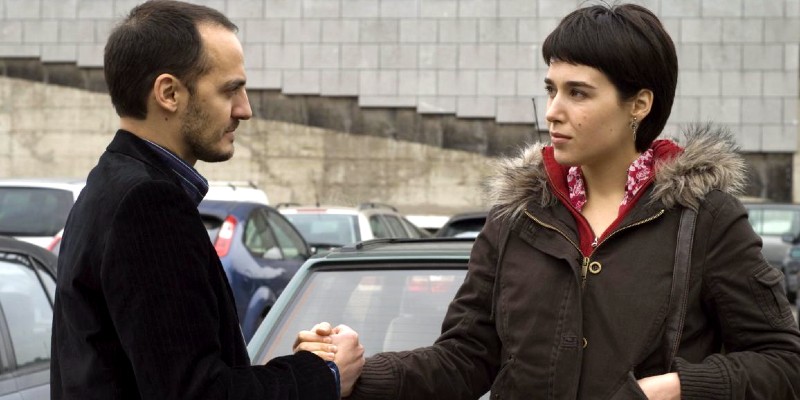
For years now, Luc and Jean-Pierre Dardenne have been making crime films . . . but no one seems to have noticed.
This is because the writer-director duo concern themselves primarily with character interiority and psychological development—the kind of thing that wins them Palme D’Or awards—not with guns or heists, nor with cops or tough guys. Their films are typically quiet affairs, stories about people on the fringes, often at odds with larger social structures. But make no mistake, the catalog of films the brothers have helmed are full of crimes and transgressions, illegal acts that figure crucially in the narratives and in the evocation of the larger themes they explore: redemption, grace, and sacrifice. Below I look at five films typical of the Belgian brothers. There are others, of course, but this selection is a good place to start to get a sense of the unique and important work of the Dardenne brothers.
La Promesse (The Promise, 1996) first brought the Dardennes some true critical attention. Like so many of their stories, it involves small time crooks, losers really. Here the criminals are not interested in big scores, but in simply getting by. They perpetrate scams in order to keep their heads above water, to earn just enough to make it to the next scam. Roger (Olivier Gourmet) and his adolescent boy, Igor (Jérémie Renier), are a father and son team who run a construction operation. They employ illegal immigrants whom they secretly ferry into industrial Seraing, Belgium. It’s a filthy, grey landscape as the directors render it, peopled by the marginalized, the underemployed, and the down and out. The pair collect money for the hovels they rent, and keep a sharp eye out for inspectors who seek to arrest illegals at the construction site Roger runs. All the way around, it’s a low-end scam, and if Roger needs to offer up a few of his workers to the cops, he’ll gladly do so in order to keep his operation running.
Yes, Roger is a scumbag, and Igor is fast becoming one.
But as with most Dardenne characters, there’s something redeeming about them, or redeemable, even if it may take a while to discover the fact. When Igor runs off from his job at the auto-garage to warn workers of a visit from immigration officials, a man is killed in the scramble. As he’s dying, he asks Igor to “take care” of his west African wife and baby boy. Igor agrees, and thus begins his reformation. Fulfilling the promise is rough going, however, because Igor doesn’t want to betray his culpable father, whose love he cherishes. And here’s where things get complicated with the Dardennes. As despicable as Roger can be, he too loves his son, though he’s corrupted him thoroughly and shows his love in questionable ways (such as giving Igor a homemade tattoo like his own, or stealing a ring to match the one he wears). In the end, like the other outcasts in these films, Igor rises and makes good on his promise, even though doing so may threaten Roger’s freedom.
La Promesse is shot in classic Dardenne style, with long takes of characters’ dirty faces, with handheld shots inside tenements and along the smoke-filled roads of the city’s industrial parks. As much as any character, the landscape and the raw style of the cinematography work to serve the larger narrative. Dardenne characters are often situated in a terrain of grit and grime, a visual allegory for their own moral place, though they sometimes do manage to get out, spiritually if not physically.

Stylistically, Rosetta (1999) takes up where La Promesse leaves off. The Dardennes favor hand-held takes in the derelict trailer park where the main character lives, and across the bleakest, most industrial settings in Seraing. Rosetta (Émile Dequenne) is a young girl, under 20 surely, whose sole motivation is to keep a job so that she can move herself and her mother (Anne Yernaux) out of the trailer park.
But there are obstacles.
The mother’s alcoholism creates a hostile environment at home, where she trades her body for rent and gas canister payments to heat the trailer. Daily, Rosetta hectors the woman for her slovenliness and devotion to drink, and in many ways the mother/daughter roles are reversed. Rosetta even attempts to get her mother into a rehab facility, but it’s a constant battle for a host of reasons, not the least of which is the fact that the woman doesn’t want to leave her trailer park paramours. Actually, she seems perfectly at ease with the situation. At one point, she plants flowers in an attempt at creating a bit of domesticity around the trailer, but Rosetta rips them from the earth. The girl simply won’t give up on a chance at what she calls a “normal life with a job.”
And herein lies the central problem. Rosetta needs steady work to realize her vision. When she loses jobs, never for reasons due to poor performance, she rages at her employers, lobbying for another chance, and inveighing against the injustices of the workplace. But nothing seems to go her way until she meets up with a boy who staffs the street waffle truck, Riquet (Fabrizio Rongione). Through him she lands a job at the bakery where the waffles are made. It’s an ideal situation, and she’s enormously pleased with herself, finally having found reliable work and gained a friend to boot. In one of the film’s saddest scenes, she speaks to herself before she falls off to sleep: “My name is Rosetta . . . I found a job . . . I made a friend . . . I have a normal life . . . I won’t be left by the wayside.”
But alas, it’s not to be. Again, Rosetta is unfairly removed from the job. And in a narrative element typical of the Dardennes, she makes a decision that jeopardizes another relationship. Specifically, she exposes a “waffle scam” in order to gain favor with her old boss and regain work. The crime in question is essential Dardenne material: a small-time graft perpetrated by a character just trying to make ends meet, someone not at all unlike Rosetta. Like La Promesse, the film’s criminal activity is enacted by the marginalized, by people just trying to remain afloat, to avoid homelessness.
Rosetta herself, in fact, illegally sets fish traps in the pond near the trailer park in order to get something to eat. It’s small time stuff, obviously, but such moments are of critical importance to the film. In scene after scene the directors follow Rosetta to her fishing haunt, where she dons her muck boots and sets her baits with freezing cold fingers. There’s no rural charm to these scenes. In the world of Rosetta, crimes are committed in order to get by, to avoid being “left by the wayside.” It’s utterly unromantic, and pathetic in the truest sense of the term. Rosetta feels awful about exposing the waffle scam, but as always with the Dardennes, there may be a moment of grace for her.
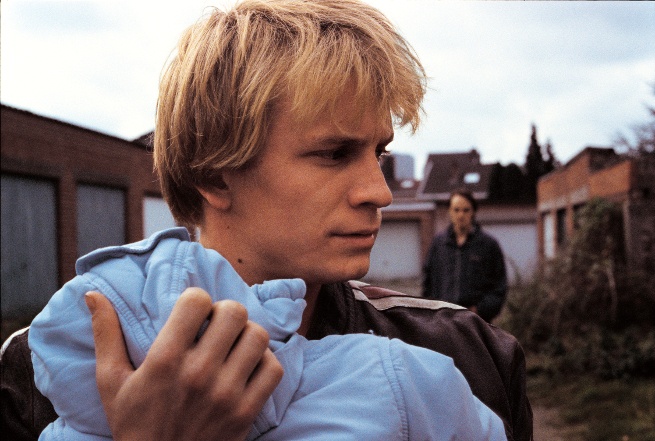
The same is true for petty thief Bruno (Jérémie Renier), of L’Enfant (The Child, 2005), a film equally as gritty as La Promesse or Rosetta. In and around Seraing, once again, the wildly immature Bruno steals and fences loot from homes, but never seems to get ahead. He and his girlfriend Sonia (Déborah François), both about 20, blow the quick scores on vanity items like leather jackets and cool hats. They shack up at the youth homeless shelter or crash at the flat they sometimes rent on the cheap. When Sonia kicks out Bruno, he sleeps under a bridge, a place where he runs his “operations,” using middle school kids to steal from flats or grab purses from unsuspecting passerby. Amazingly, the fact that Sonia has just given birth to his baby does nothing to change Bruno’s outlook. “Work is for fuckers,” he tells her when she encourages him to consider a job as a handyman. And just when we think Bruno could be no more irredeemable . . . he does something utterly irredeemable.
Though Sonia is normally as juvenile as Bruno, her boyfriend’s latest scheme involves the baby, and she draws a line. Now Bruno must reverse course in order to regain her love. As infantile as the couple generally act, the viewer genuinely feels their love for one another—and thus the importance of redemption for Bruno. It’s all managed by way of long, often cringe-worthy scenes where the two behave like adolescents, even as the baby rides in the backseat of a moving car on the highway, or as he sleeps unattended while the two wrestle playfully in a park. Yes, they are maddening, but it’s their pure love that the directors manage to convey, their genuine connectedness, though model parents they’ll never be.
To recapture this love, Bruno spends much of the film in an effort to right the wrong he’s committed, but things go sideways fast and he schemes to get back on track. Through the journey, he comes to realize things about himself, about life, about responsibilities. It’s all conveyed in classic Dardenne style: with long takes where Bruno watches a character and thinks about the wayward course he’s followed; or with the use of small props, like a baby stroller, to suggest an enlightened consciousness; or even by way of interactions with the younger thieves whom he tutors. In the end, Bruno trudges across the filthy city, dangerously crossing highways on foot while pushing a heavy, broken down motorbike. The journey becomes a penance, a quest for redemption. Like Rosetta and Igor, he’s chooses righteousness in the end, though what he must pay for it is dear indeed.
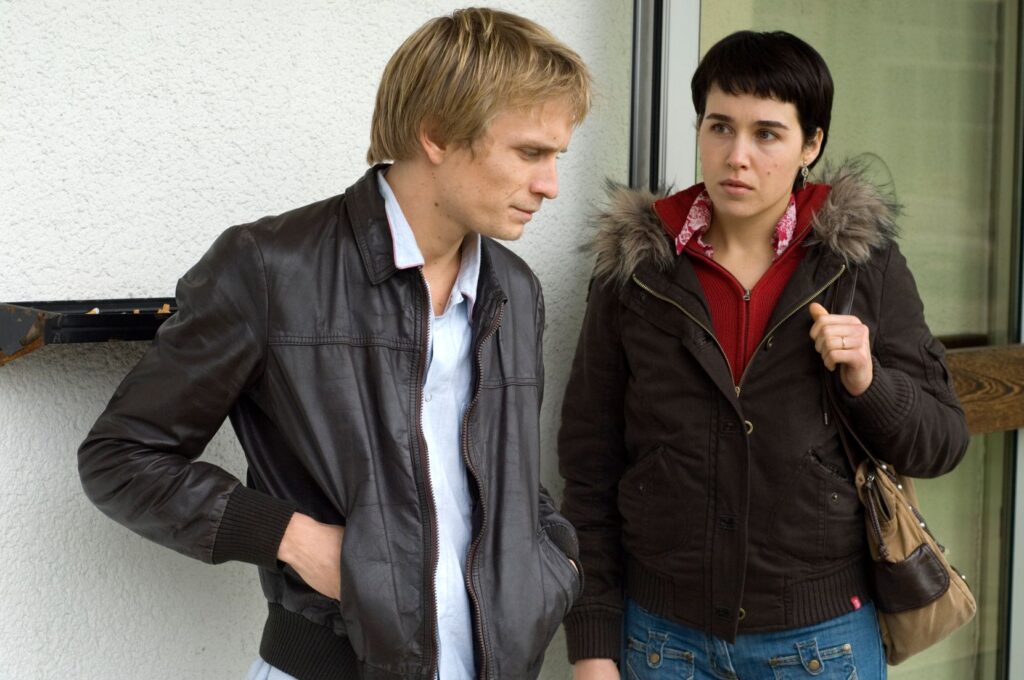
Le Silence de Lorna (Lorna’s Silence) (2008) again involves the journey from criminality to righteousness. Lorna (Arta Dobroshi) is an Albanian woman living and working in Liege. In order to get Belgian citizenship, she’s married a junkie named Claudy (Jérémie Renier), a citizen who’s been paid for the arrangement. He’s also been promised a bigger…
