
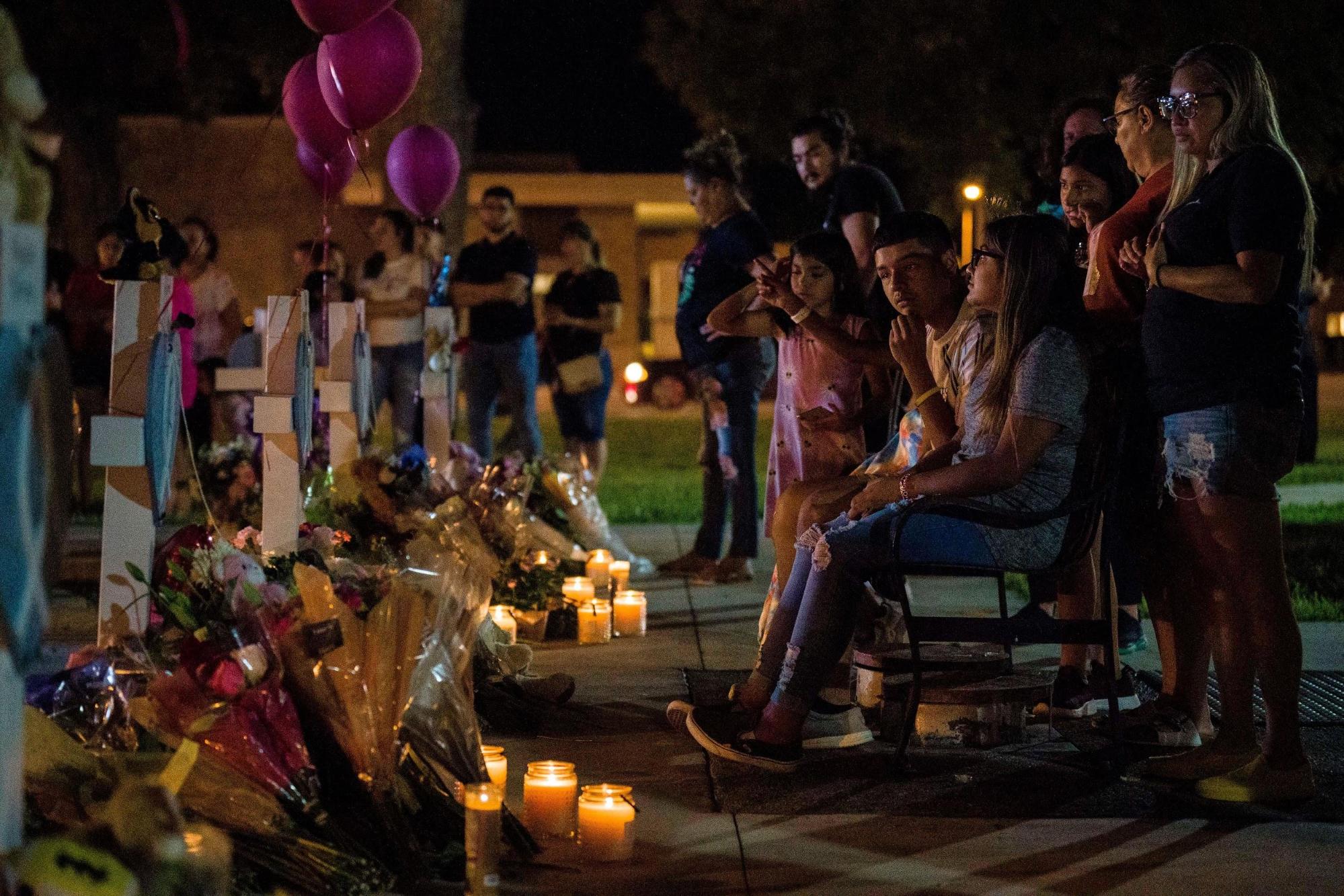
This story was produced in partnership with URL Media and originally published by NAHJ: palabra.
For so long, the people of South Texas have been expected to sacrifice their communities to a border security apparatus. Drones, helicopters, and agents have saturated cities and towns where residents have gone without health insurance and send their children to underfunded schools. It was this apparatus that responded in late May when a gunman rampaged through an elementary school classroom in Uvalde, killing children—19 in all—and two teachers.
Hundreds of state troopers, federal immigration agents, sheriff’s deputies, U.S. Marshals, and local police quickly descended on a town of 15,000, set among ranchlands 80 miles southwest of San Antonio and 60 miles from the border with Mexico. That rapid influx reflected the deep penetration of the border security apparatus in the region. And it was members of that apparatus, a tactical team that included Border Patrol agents, that Governor Greg Abbott and Texas Department of Public Safety Director Steve McCraw credited with charging into a classroom and killing the gunman.
But amid the public speculation about the causes that may have motivated a young man to kill third and fourth graders, that apparatus went almost unmentioned. Abbott and McCraw, whose agency is leading the investigation into the massacre, grasped at familiar themes—mental illness, video games, bullying. Speculation quickly morphed into purpose, with Abbott soon calling a special legislative session tasked with ginning up “recommendations on school safety, mental health, social media, police training, firearm safety, and more,” implicitly validating certain factors and rejecting issues that Republicans shun, specifically: gun control.
Outraged elected officials and a horrified public across the ideological spectrum argued that lax gun laws had made it easier to acquire an AR-15 than to register to vote. Hours after the massacre, an anguished President Joe Biden asked in a national address: “Another massacre. Uvalde, Texas … And how many scores of little children who witnessed what happened see their friends die as if they’re on a battlefield, for God’s sake.”
But the Uvalde massacre occurred in an existing, de facto war zone. The border security apparatus created by elected officials—Republicans and Democrats—has converted South Texas communities into a real and symbolic theater, complete with armed agents and heavy weapons, to project an image of toughness and power.
Ignored in the speculative narrative was the possibility that a border security apparatus created by state and federal officials, powered by white supremacy and political vitriol, that peddles violence and subjects people migrating through the region to inhumane and brutal conditions, may have created a climate primed for a monstrous expression of toughness and power.
The violent worldview and the brutality imposed on the region are obvious to anyone who reads the local newspaper, watches television news, or looks out the window. Representative Tony Gonzales, (R-TX), who represents Uvalde, told Fox News back in 2021, “Life on the border is hell for us.” And three days before the massacre, Uvalde Mayor Don McLaughlin, an occasional guest on the network, returned to Fox News, repeating Republican talking points about migration. “The border is wide open,” he said before making an unsubstantiated claim that migrating people caused the recent spike in COVID-19 cases.
In the constructed war zone around Uvalde, violence and inhumanity are openly encouraged.
Politicians already had demonstrated that a violent worldview could put South Texas on the national news media map. How else, but with a narrative of violence, can a relatively obscure congressman gain a spot on national newscasts? How else does a mayor of a Texas town of 15,000 residents attract a media spotlight?
The day before the massacre, Governor Greg Abbott was photographed 60 miles from Uvalde, at the border in Eagle Pass, ostensibly gazing at concertina wire he had ordered unfurled along the Rio Grande to promote an image of toughness and power. Days before, the gunman had circulated photographs of himself with his military-style weapons on social media, apparently to project an image of toughness and power.
A “quest for fame and notoriety” is commonly found among mass shooters, Jillian Peterson, co-author of The Violence Project: How to Stop a Mass Shooting Epidemic, told Politico after the Uvalde massacre. The path to the making of a mass shooter, she said, is marked by self-loathing, hopelessness, and despair, a self-hatred that turns outward.
A Constructed War Zone
That the gunman was Latino and his victims were largely Latino children attending a historically segregated “Mexican school” does not reflect the absence of race and racism. On the contrary, it may well have been the consequence of an apparatus tinged with nativism and racism that stokes self-hatred.
“This (shooting) emerges out of the violence that has been inflicted on the Mexican American community of South Texas: the economy of the region encourages them (Latinx) to see other ethnic Mexicans as aliens, as their enemies, as non-human,” A. Naomi Paik, author of “Bans, Walls, Raids, Sanctuary: Understanding U.S. Immigration for the 21st Century” and Ana Minian, professor of history at Stanford University, told palabra in a joint written statement.
In the constructed war zone around Uvalde, violence and inhumanity are openly encouraged. Down the road from Uvalde, in Kinney County, the sheriff’s office has shared online posts that compared migrating people with hunting prey, according to a federal civil rights complaint filed by the American Civil Liberties Union of Texas and the Texas Civil Rights Project. Local ranchers and state troopers, according to the complaint, have worked in tandem to subject migrating people, mostly Latino and Black men traveling through the region, to criminal trespass charges under the governor’s latest border security gambit, Operation Lone Star. Images of those arrests became, in the hands of the governor, trophies to broadcast on social media.
Upon arrest, migrants are thrust into a newly state-created byzantine criminal justice system that a coalition of federal defenders described in a letter to the U.S. Justice Department as a “shadow criminal legal system” operating parallel to the formal justice system. Reports of inhumanity documented in the civil rights complaint included physical and racist verbal abuse and worm-ridden food. South Texas was a regular witness to an apparatus of inhumanity and cruelty under the guise of an immigration and border security apparatus.
Weeks before the massacre, the Uvalde government posted an affidavit for ranchers to authorize arrests of migrants on their property after county officials signed onto Operation Lone Star. In exchange for backing Abbott’s initiative, Uvalde County, where household income is a third lower than the national median of $45,000, received $3.3 million for “border security,” which was used for trimming trees, and installing Internet cables and other infrastructure, according to the Uvalde Leader News.
“Immersed in a region targeted by the federal and Texas state governments to police Latinx people and migrants,” Minian and Paik wrote, “is it surprising that (Uvalde shooter, Salvador) Ramos took up violence on his own, against “his own?”
Historically, shaming and humiliating migrants fits within Texas’ sordid history of denigrating Mexican-American identity and culture with policies that, for example, abused school children for speaking Spanish. Robb Elementary School, the site of the massacre, was a flashpoint in the local resistance against a white minority rule that used law enforcement and policies to segregate and subjugate Latino and Latinas. It was also the site of resistance during the Chicano civil rights era of the 1970s.
Parents and students organized walkouts to denounce the town’s segregated school system and the lack of Chicano political representation. Back then, a white superintendent oversaw the “Mexican” schools,” including Robb.
In 1980, the U.S. Justice Department sued the school district, alleging racial discrimination and policies that diluted the voting power of Mexican Americans. Latinos made up more than 50% of the population, but at-large school board elections had been engineered to ensure that no Mexican Americans won enough votes. The city and schools were deeply segregated, according to the federal lawsuit, and “unresponsive” to the needs of Mexican Americans.
Three decades later, in Latino-majority Uvalde, the mayor, school superintendent, city attorney, and most of the school board administration are white. When local residents organized a Black Lives Matter protest two years ago, Mayor McLaughlin responded by imposing a curfew, and the border security apparatus intervened with the deployment of a Customs and Border Protection helicopter to police the protest.
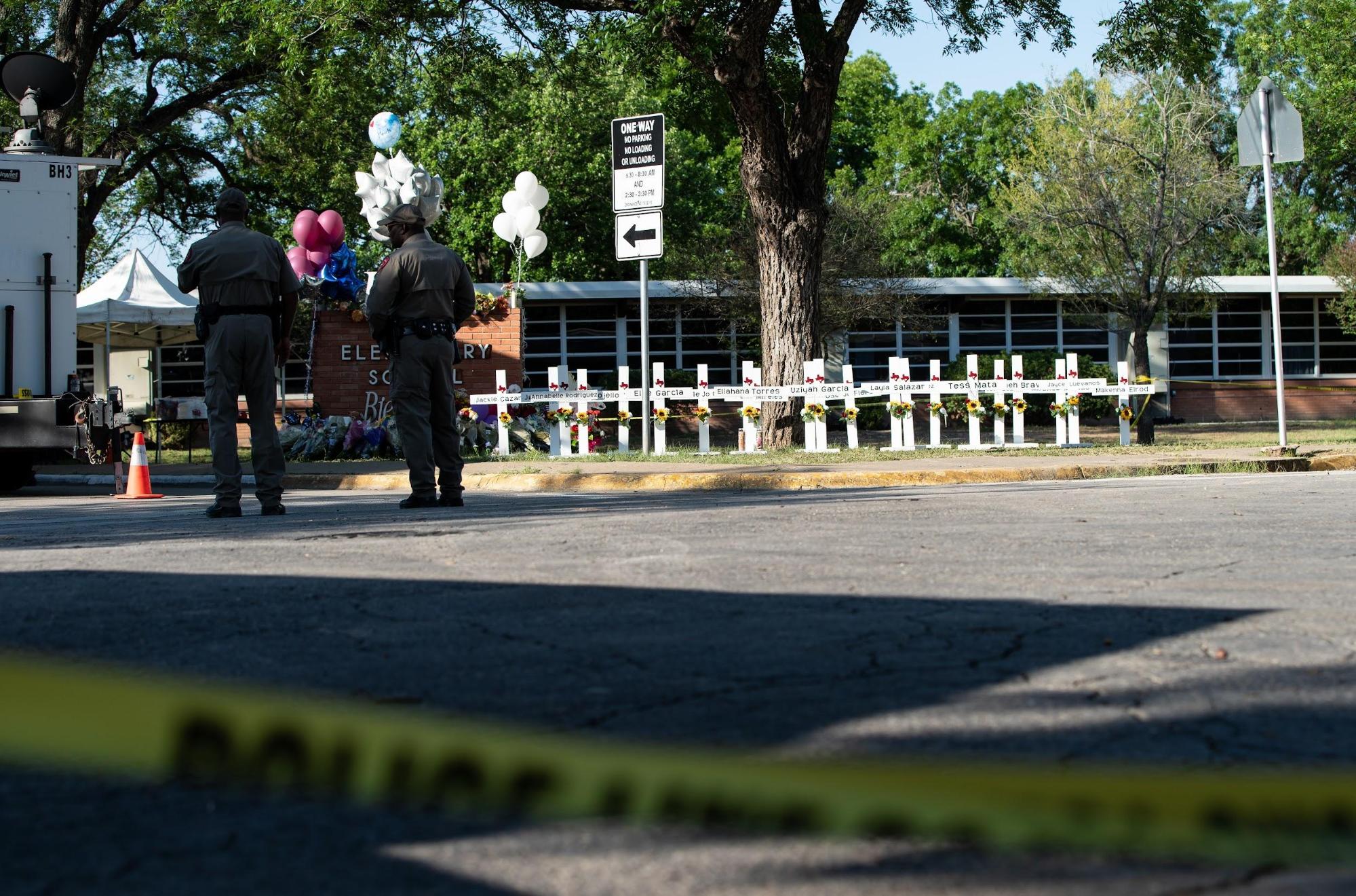
Tentacles of the security apparatus reach far beyond the official objectives of immigration and border enforcement. It has spread nearly 100 miles north into counties like Uvalde and involves intense policing of citizens and non-citizens alike. In some counties, it is possible to spot state troopers on every street corner or posted every one-half mile along South Texas highways.
Under Operation Lone Star, at least 1,000 state troopers have been deployed across South Texas. Most of the resulting arrests have been related to the…
