
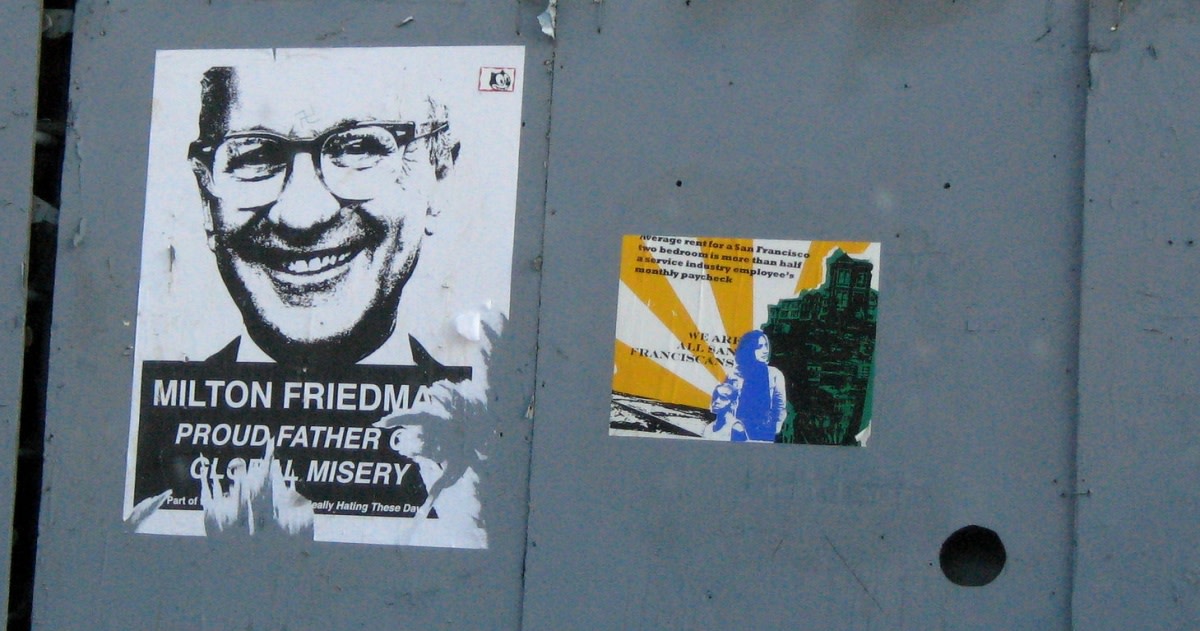
Underlying FDR-era Democratic Capitalism were the economic theories of John Maynard Keynes, who posited that strategic government intervention in the economy would have long term positive consequences. He didn’t advocate full-on, generalized central planning—he colored within capitalist lines overall—but his economic philosophy skewed toward the greater good for the greater number. Antithetical to Keynes were free market policies touted by theorists like Frank Knight, Milton Friedman and their Chicago School of Economics cohort. (Please take a moment to Google Chicago School of Economics.)
Much of the mischief the US caused in Latin America was instigated by Friedman, his fellow Chicago School proselytizers, and their students (please take a moment to Google Chicago Boys, whose experiments in Chile generated widespread misery). Friedman’s free market theories resonated with right-wing policymakers: Margaret Thatcher and Ronald Reagan were true believers. Friedman et al. provided capitalists with intellectual and moral cover (once God was recruited so that Marxism could be declared immoral and evil) for overthrowing unsatisfactory, i.e., insufficiently capitalist, Latin American governments. For Chicago School cultists, Latin America provided once-in-a-lifetime opportunities to test free market theories with expendable Latin Americans serving as lab mice.
Once a Latin American country’s anti-socialist government was installed and stabilized, Chicago School…
