
One of the consequences of the financial crisis that gets little airplay these days is the slow extinction of fund-of-hedge funds. They’re not dead yet of course (there’s still about $644bn in them), but it’s pretty much the only corner of the investment industry that has flatlined or shrunk over the past decade.
Fund of funds made make an alluring promise to investors. For a fee, they find the finest hedge fund managers on the planet, combine them into a diversified, uncorrelated and high-returning portfolio, monitor their performance and occasionally cull the weakest from the herd.
In reality, in many cases it is simply another fat layer of fees over a compensation scheme masquerading as an asset class, which has ended up producing dismal results. That several big funds-of-funds invested in Bernard Madoff’s Ponzi scheme hammered home how feckless some of them were, and soured a generation of investors against the vehicles.
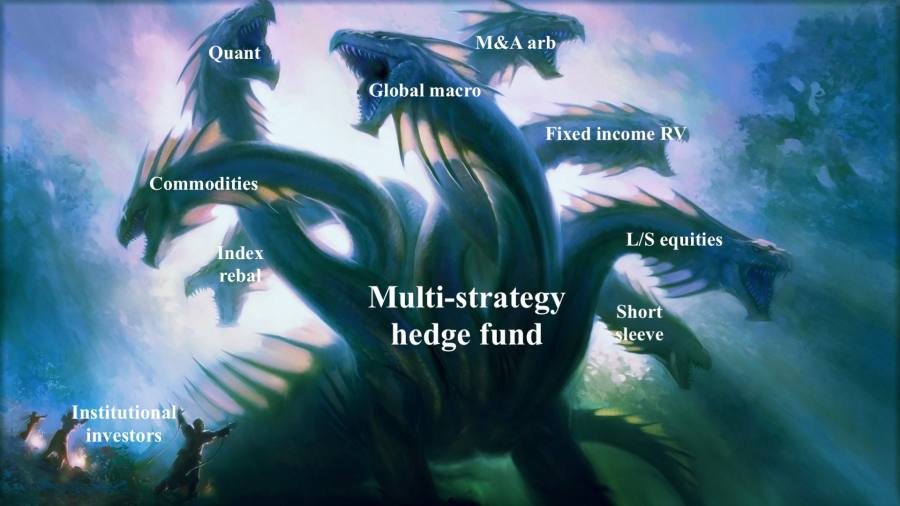
However, the basic model outlined above will sound familiar to some Alphaville readers, as this is pretty much the model of “multi-strategy” hedge funds like Millennium, Citadel, Point72, Balyasny or Schonfeld.
I’m not quite ready to die on this hill, but I reckon that multistrats should essentially be seen as a souped-up, better version of old-school fund-of-funds. They will eventually supplant them completely — and could ultimately dominate the hedge fund industry as a whole.
To be honest, they already have eclipsed…
