
Thom Hartmann is a progressive nationally and internationally syndicated talk show host. Talkers Magazine named him America’s #1 most important progressive host and the host of one of the top ten talk radio shows in the country every year for more than a decade. His latest book, The Hidden History of Neoliberalism: How Reagan Gutted America and How to Restore Its Greatness publishes September 13.
In America, it was inflation that opened the door to Milton Friedman’s neoliberalism.
Inflation is usually caused by one of two things: international devaluation or internal dilution of a country’s currency, or widespread shortages of essential commodities that drive up prices enough to echo through the entire economy.
The early 1970s got both, one deliberately and the other as the result of war.
Between 1971 and 1973, President Nixon pulled the United States out of the Bretton Woods economic framework that had been put together after World War II to stabilize the world’s currencies and balance trade. The dollar had been pegged to gold at $35 an ounce, and the world’s other currencies were effectively pegged to the dollar.
But the United States couldn’t buy enough gold to support the number of dollars we needed as our economy grew, so on August 15, 1971, Nixon announced to the nation and the world that he was taking the dollar off the gold standard and putting a 10 percent tariff on most imports of finished goods into the US to deal with the changes in the dollar’s value relative to other currencies.
The immediate result was that the value of the dollar rose as the world breathed a sigh of relief that the “gold crisis” was coming to an end and the dollar would become more portable. But an increased value in the dollar relative to other currencies meant that products manufactured in the US became more expensive overseas, hurting our exports.
At that time, there were 60,000 more factories in the US than today, and Walmart was advertising that everything in their stores was “Made in the USA”: exports were an important part of our economy, and imports were mostly raw materials or “exotic” goods not produced here, like sandalwood from Thailand or French wines.
To deal with the “strong dollar” problem, Nixon announced in December 1971 that the US was devaluing our currency relative to the Japanese yen, German mark, and British pound (among others) by 11 percent. It was the first-ever negotiated realignment of the world’s major currencies, and Nixon crowed that it was “the greatest monetary agreement in the history of the world.”
But we were still importing more and more goods from overseas, particularly cars from Japan, increasing our trade deficit and hurting American jobs that manufactured goods like cars that competed with the Japanese and the Germans. So in the second week of February 1973, Nixon did it again, negotiating a further devaluation of the dollar by 10 percent.
While devaluing the dollar against other currencies didn’t have much immediate impact on products grown or made in the United States from US raw materials, it did mean that the prices of imports (including oil, which was the primary energy supply for pretty much everything in America) went up.
Over the next decade, the impact of that devaluation would work its way through the American economy in the form of a mild inflation, which Nixon thought could be easily controlled by Fed monetary policy.
What he hadn’t figured on, though, was the 1973 Arab-Israeli War. Because America took Israel’s side in the war, the Arab states cut off their supply of oil to the US in October 1973. As the State Department’s history of the time notes, “The price of oil per barrel first doubled, then quadrupled, imposing skyrocketing costs on consumers and structural challenges to the stability of whole national economies.”
Everything in America depended on oil, from manufacturing fertilizer to powering tractors, from lighting up cities to moving cars and trucks down the highway, from heating homes to powering factories. As a result, the price of everything went up: it was a classic supply-shock-driven inflation.
The war ended on January 19, 1974, and the Arab nations lifted their embargo on US oil in March of that year. Between two devaluations and the explosion in oil prices, inflation in the US was running red-hot by the mid-1970s, and it would take about a decade for it to be wrung out of our economy through Fed actions and normal readjustments in the international and domestic marketplace.
But Americans were furious. The price of pretty much everything was up by 10 percent or more, and wages weren’t keeping pace. Strikes started to roil the economy as Nixon was busted for accepting bribes and authorizing a break-in at the Democratic National Committee’s headquarters in the Watergate complex. Nixon left office and Gerald Ford became our president, launching his campaign to stabilize the dollar with a nationally televised speech on October 8, 1974.
Ford’s program included a temporary 5 percent increase in top-end income taxes, cuts to federal spending, and “the creation of a voluntary inflation-fighting organization, named ‘Whip Inflation Now’ (WIN).” The inflation rate in 1974 peaked at 12.3 percent, and home mortgage rates were going through the roof.
WIN became a joke, inflation persisted and got worse as we became locked into a wage-price spiral (particularly after Nixon’s wage-price controls ended), and President Ford was replaced by President Jimmy Carter in the election of 1976.
But inflation persisted as the realignment of the US dollar and the price of oil was forcing a market response to the value of the dollar. (An x percent annual inflation rate means, practically speaking, that the dollar has lost x percent of its value that year.)
The inflation rates for 1977, 1978, 1979, and 1980 were, respectively, 6.7 percent, 9.0 percent, 13.3 percent, and 12.5 percent.
In 1978, Margaret Thatcher came to power in the United Kingdom and, advised by neoliberals at the Institute of Economic Affairs (IEA), a UK-based private think tank, began a massive program of crushing that country’s labor unions while privatizing as much of the country’s infrastructure as she could, up to and including British Airways and British Rail.
She appointed Geoffrey Howe, a member of the Mont Pelerin Society and friend of Milton Friedman’s, as her chancellor of the exchequer (like the American secretary of the Treasury) to run the British economy. Friedman, crowing about his own influence on Howe and the IEA’s founder, Sir Antony Fisher, wrote, “The U-turn in British policy executed by Margaret Thatcher owes more to him (i.e., Fisher) than any other individual.”
The ideas of neoliberalism had, by this time, spread across the world, and Thatcher’s UK was getting international applause for being the world’s first major economy to put them into place. Pressure built on President Carter to do the same, and, hoping it might help whip inflation, he deregulated the US trucking and airline industries, among others, in the last two years of his presidency.
Ronald Reagan was elected in 1980, and when he came into office, he jumped into neoliberal policy with both feet, starting by crushing the air traffic controllers’ union, PATCO, in a single week. Union busting, welfare cutting, free trade, and deregulation were the themes of Reagan’s eight years, then carried on another four years by President George H. W. Bush, whose administration negotiated the North American Free Trade Agreement (NAFTA).
America was now officially on the neoliberal path, and Friedman and his Mont Pelerin buddies were cheering it on.
By 1982, inflation was down from 1981’s 8.9 percent to a respectable and tolerable 3.8 percent; it averaged around that for the rest of the decade. Instead of pointing out that it normally takes a supply-shock inflation and a currency-devaluation inflation a decade or two to work itself out, the American media gave Reagan and neoliberalism all the credit. Milton Friedman, after all, had made his reputation as the great scholar of inflation and was a relentless self-promoter, appearing in newspapers and newsmagazines almost every week in one way or another.
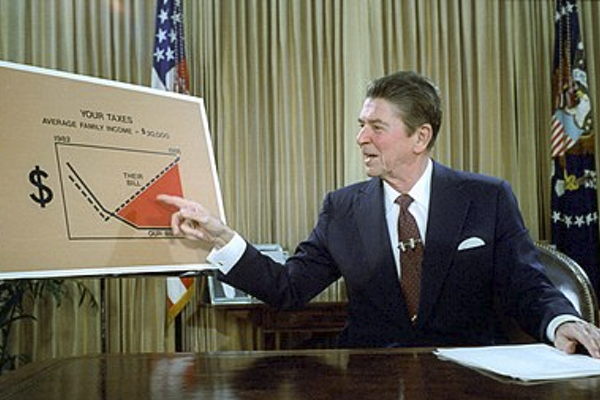
Claiming that neoliberal policies had crushed over a decade of inflation in a single year, and ignoring the fact that it was just the normal wringing-out of inflation from the economy, Reagan openly embraced neoliberalism with a passion at every level of his administration. He embarked on a series of massive tax cuts for the morbidly rich, dropping the top tax bracket from 74 percent when he came into office down to 25 percent. He borrowed the money to pay for it, tripling the national debt from roughly $800 billion in 1980 to $2.4 trillion when he left office, and the effect of that $2 trillion he put on the nation’s credit card was a sharp economic stimulus for which Reagan took the credit.
He deregulated financial markets and savings and loan (S&L) banks, letting Wall Street raiders walk away with billions while gutting S&Ls so badly that the federal government had to bail out the industry by replacing about $100 billion that the bankers had stolen.
“Greed is good!” was the new slogan, junk bonds became a thing, and mergers and acquisitions experts, or “M&A Artists” who called themselves “Masters of the Universe,” became the nation’s heroes, lionized in movies like the 1987 Wall Street, starring Michael Douglas.
Reagan signed Executive Order 12291, which required all federal agencies to use a cost-benefit estimate when putting together federal rules and regulations. Instead of considering costs of externalities (things like the damage that pollution does to people or how bank rip-offs hurt the middle class), however, the only costs his administration worried about were expenses to industry.
He…
