
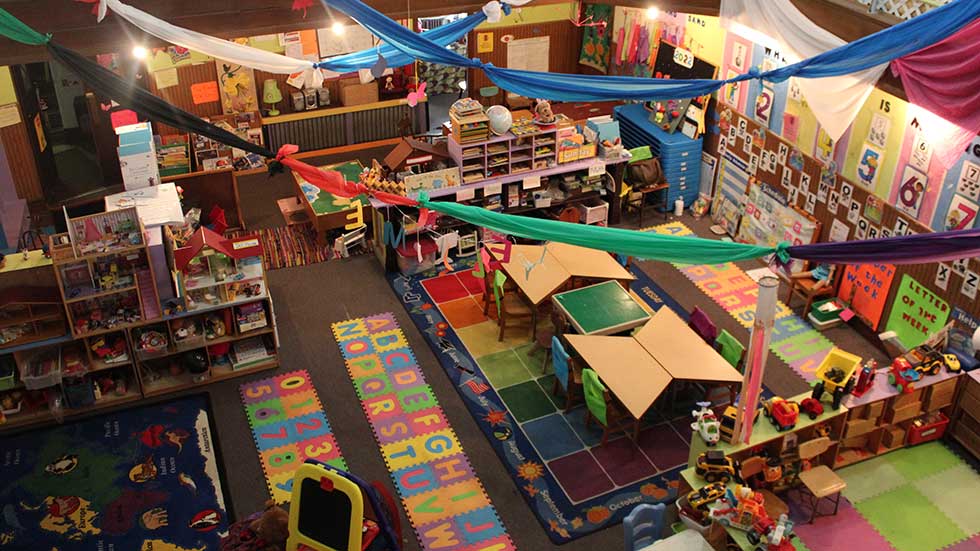
The Ever Changing Educational Center operates out of a 110-year-old tan brick church on St. Clair Ave. and serves as a day care center for 12 Cleveland kids. Its director, Valentina Randle, has decades of experience working with children in the Forest Hills neighborhood, and the center has a top 5-star rating under Ohio’s Step Up to Quality standards.
Randle knew her building was old, and she wanted to make sure that her kids were drinking safe, lead-free water.
So when she received an email from Cleveland Water offering to test the building’s main service line – that’s the pipe leading from the public water main to the building – for lead and pay for any necessary replacements, she immediately took advantage of the opportunity.
Since July 2021, Cleveland Water has inspected water lines at all 445 state-licensed child care facilities in Cuyahoga County that were built before 1953, when the utility stopped using lead pipes. Every time it found lead or lead-contaminated service lines – which turned out to be in over half of those 445 facilities – the lines were replaced.
The Cleveland Water inspection and replacement program initially faced challenges reaching child care providers. The pandemic slowed the arrival of notices by physical mail, and child care providers were wary of potential email scams and had concerns about construction work interrupting their child care services.
But through repeated outreach efforts and an open dialogue with providers, Cleveland Water has replaced lead service lines which could have impacted hundreds of children and has helped providers gain access to additional water safety resources available through the Ohio Department of Health.
State funding addressed lead pipes serving day cares
Through its H2Ohio program, the state awarded the city of Cleveland $500,000 in June 2021 to replace any lead water service lines – the pipes that connect the public water main to a customer’s inside plumbing – at child care centers in the city. In the announcement, Governor Mike DeWine said government officials needed to “be aggressive” in efforts to prevent children from consuming water tainted with lead.
Brenda Culler, Cleveland Water’s lead removal program manager, agreed with this priority. “We wanted to make sure with the program that we had planned on doing child care centers first, because that is where we can have the highest impact in the most efficient manner,” she said.
Under the state grant program, Cleveland Water was charged with the task of ensuring none of Cuyahoga County’s more than 1,000 licensed child care providers had lead water service lines leading into the buildings.
Between July 2021 and April 2022, Cleveland Water officials, under the direction of Culler, inspected 445 child care facilities located in buildings built before 1953, the year Cleveland Water stopped using lead service pipes. The remainder of the facilities were not inspected because of their newer construction dates.
Initially, these efforts were sluggish. Culler said this was largely due to mail service slowed by Covid-19 and tentativeness from providers who weren’t sure the program was legitimate.
“We realized the mail was really delayed and we don’t even know if these letters got delivered, so I started [sending] regular emails to the child care centers encouraging them to participate,” she said.
“When you’re sorting through your emails, you have in your brain ‘Is this spam or is this a real offer?’ … your initial reaction is, you know, ‘Whatever, delete.’ It’s what I would have done myself, if I was the in-home operator, especially.”
But Culler was persistent, and as she continued to reach out, child care providers increasingly began to respond by phone and email asking for more details.
The church section of 12651 St. Clair Ave., home to Ever Changing Educational Center, is over 110 years old and was constructed well before lead pipes were federally banned in 1986. Cleveland Water stopped using lead service lines in 1953. [Owen MacMillan / The Land
Beyond service lines: lead plumbing inside day care centers
One of the earliest responders to Cleveland Water’s outreach was Randle, the director of Ever Changing Educational Center.
“I responded immediately,” Randle said. “I called and I spoke with a representative, and they explained the program to me. Since we are housed in a church, we are accustomed to programs reaching out to our building for services, so I didn’t think it was strange.”
She said participating in the program was simple and easy from start to finish.
Cleveland Water found that Ever Changing’s main service line – again, the pipe leading from the public water main to the building – was made out of copper, not lead, so there was no need for replacement. However, a building that old can have interior lead pipes and fixtures which can also be a source of dangerous lead in drinking water, so Randle was put in contact with the Ohio Department of Health (ODH) for additional testing.
Under a separate program, the ODH uses funding from a federal EPA grant to offer free lead testing of water at licensed child care providers in Cuyahoga and Hamilton counties. For this inside water testing, ODH has hired outside contractor Tetra Tech to do the tests.
At Ever Changing, Tetra Tech’s testing found unsafe lead levels in the day care’s water, but only in one bathroom sink in the basement of the facility.
Randle said although she explained the bathroom is seldom used and that the sink is never used to provide drinking water, ODH sent her Brita water filters and paid for a plumber to replace the fixture.

Tetra Tech testing found that one bathroom in the basement of Ever Changing had unsafe levels of lead. The Ohio Department of Health paid for a plumber to solve the issue. [Owen MacMillan / The Land]
“It was excellent,” she said. “They set up an appointment to come out and gave me the parameters in which they needed things to be. The person came out, tested the water, then communicated the findings with me. Everything was very straightforward.”
That initial process took about six weeks, and although Randle is still waiting for the plumber to return, she said she is pleased with the ODH program.
“It was a painless process; there was no disruption of our services,” Randle said. “We didn’t really know the plumber was even there. He came into the building, and he did what he needed to do. Once she came back out to test again and it indicated lead was still present, I got those pitchers within two days.”
Randle has been waiting two months for the plumber to return and finish the project, but she said, based on her experience so far with the Cleveland Water and Ohio Department of Health lead removal programs, she is confident the work will be done.
“They have done such a good job up to this point, I can’t imagine them dropping the ball now,” she said. “But if they do, I won’t let them forget about me and my kids.”
Jenna Portik, director of the Bethesda Child Care Center in Bay Village, also reached out to Cleveland Water over the phone after she received a message via Culler’s email campaign.
“The woman I worked with was extremely thorough but very nice, clearly cared about what she was doing, and clearly wanted to work with us to make sure it worked on our schedule and that they did everything correctly,” Portik said.
Bethesda Child Care Center operates out of Bethesda on the Bay Lutheran Church. Portik said Cleveland Water worked to avoid interrupting either child care or church activities when scheduling testing and plumbing work. Like Ever Changing, Bethesda did not have a lead service line, so Cleveland Water sent Portik to the ODH for assistance in replacing lead plumbing inside the day care center.
“They came in in the early hours of the morning, and they tested every sink that is in the center as well as the church, so that’s a lot.”
The test results found that, like Ever Changing, water from just one bathroom sink on the premises had high levels of lead.
Portik said within another couple of weeks, a plumber corrected the issue, and the water was retested to confirm it was safe. She commended the speed and commitment of the officials who worked on her case.
“Child care centers, and the early childhood field in general, are usually the bottom of the barrel,” she said. “We aren’t paid well, we’re not appreciated much, so the fact that they were so eager to help and it was such a smooth and easy process was definitely appreciated.”

The Bethesda Childcare Center is attached to the Bethesda On the Bay Lutheran Church. [Owen MacMillan / The Land]
Reaching participants
Cleveland Water’s repeated effort to contact child care facilities led to quick increases in participation. Culler said as more providers signed up for the program, she asked how they’d been convinced to sign up.
“They said ‘You kept trying. You kept trying to find different ways to communicate the same message with us that, you know, we realized that this wasn’t a scam and it was real,’” Culler said.
Of the 445 providers in Cuyahoga County that Cleveland Water identified as potentially having lead service lines, about half were eventually signed up. Then Culler decided it was time to take more direct action to enroll providers into the program.
“We went from a reactive, ‘Hey, come to us and we’ll do this’ to proactively saying ‘We’re coming and we’re going to help you take care of a problem you might not even know you have,’” she said.
The more forceful stance resulted in every remaining provider that still needed to be tested signing on to the program, except for one.
“I only had one person who emailed back a negative response. That was simply the word no,” Culler said. Culler was insistent, though, and she told that person, “‘We’re going to be doing this…
