
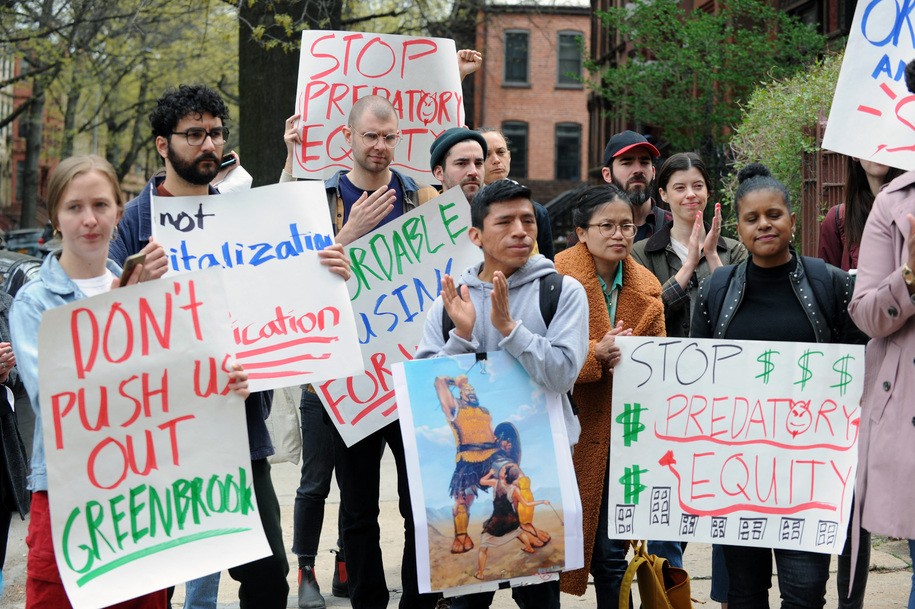
“Gentrifying neighborhoods are most vulnerable to real estate scams, especially where the neighborhoods have seen dramatic changes, particularly with race and income demographics,” said Noelle Eberts, supervising attorney of consumer protection at New York Legal Assistance Group (NYLAG).
After years of neglect by the city, the area has suddenly become a gold mine, one that arguably is more likely to put homeowners at risk than benefit them. And residents—particularly Black and brown families—are being left to fend for themselves as they become prime targets for devastating scams that can steal homes and their value, leaving families bankrupt, deeply in debt, unhoused, or worse.
Losing a home in Bed-Stuy
Bed-Stuy is home to one of the first free Black communities in the U.S., a community originally known as Weeksville when it was founded in the mid-1800s. The area remained predominantly Black until the early aughts; due to the practice of “redlining,” this was one of the only areas where the Black population in New York could buy property.
Sherlivia Thomas-Murchison was raised in Bed-Stuy public housing before her mother, Margaret Blow, and their neighbors were able to purchase the city-owned property they lived in through the TIL (Tenant Interim Lease) program. At the time, the building was infested by rats and cockroaches and had to be overhauled.
“The roaches would get into our food in the cabinets—we would have to shake roaches out of our cereal first,” Thomas-Murchison said.
Blow and her collaborators formed a cooperative to buy a building on Madison Street in 1991 and refurbished it. In fact, despite being only 19 years old at the time, Thomas-Murchison herself purchased one of the apartments in the building for $2,000. She did this at her mother’s urging—Blow wanted to ensure her children would be financially secure.
But in 2018, Thomas-Murchison’s family home was one of about 700 properties seized by New York City’s department of Housing Preservation & Development (HPD) as a part of the controversial Third Party Transfer (TPT) program, through which city officials can declare an owner unfit to care for their asset and reassign that asset to a third party. The program ostensibly only seizes properties if they show “significant delinquent municipal charges and poor housing conditions,” but buildings have been seized for myriad perplexing reasons, including the proliferation of deed and equity frauds in Central Brooklyn. But residents like Thomas-Murchison have stated that the program seizes housing in ways that mimic deed theft with the official stamp of the city. For property to be seized through TPT, the action must be approved by city council members who, according to Councilmember Robert Cornegy, lack the time and resources to inspect the homes in question. At a 2019 city council meeting, Cornegy was adamant that HPD staff had misled the council members as to the state of the properties. “Did every council member go to every third party transfer on the list in their district and visit them?” said Cornegy, “No […] I did visit a couple, but there were so many on my list that it wasn’t even humanly possible even in that period to visit them.”
Thomas-Murchison is currently part of a class-action lawsuit against the city that will be heading to trial.
How to steal a house
According to Eva Velasquez, president and CEO of the ID Theft Resource Center, the system for registering property ownership in the U.S. is “fractured.” She describes a convoluted framework that changes from county to county, creating confusion among homeowners—especially those who may not be comfortable with checking on their property registration online or have access to a computer and internet connection with which to do so. As a result, the system can be vulnerable to forgery, particularly if the home in question isn’t occupied, as in the case of a second home or an inherited property.
Scammers will forge a new deed and file it with the County Clerk’s office, changing the ownership of someone’s property without their knowledge. Forgers can falsify notarization for property registration that overworked assessor’s office clerks might miss, notarize documents themselves, or work with notaries in on the scheme. Further, a notary public needs only to notarize a document after it has been signed and can be lax in checking someone’s identification. Once a document gets notarized, it will be filed with the County Clerk, no questions asked, and the house will belong to the scammer.
While forgeries are often clear-cut criminal cases, Toby Cohen, a real estate attorney with extensive experience in deed fraud, says that it’s harder to prevent scammers from making false promises to desperate homeowners and using shell corporations to move properties around. Both deed theft—stealing someone’s home—and equity theft—stealing the value of someone’s home, sometimes while they’re still living in it—can be some of the hardest crimes to prosecute in the courts, often due to perpetrators’ use of shell corporation structures to distance themselves from the theft.
“[Deed theft by con artists] tends to happen more in communities of color,” said Gloria Sandiford, president of the Bedford-Stuyvesant Real Estate Council, who was born and raised in Bed-Stuy. “I’ve seen more stories than I care to go into, all very disturbing.”
For instance, a con artist can mislead a homeowner into signing away their rights without disclosing what it is they’re signing, or pressure someone with money troubles to sign away a property with the promise of repaying debts. The problem is that this type of crime rests in a gray area between civil and criminal because homeowners do sign documents, even under false pretenses, and are of sound mind when they do so, Velasquez says. It’s also difficult to prove because it requires giving evidence of intent when “it’s almost impossible to try to get inside someone else’s head.” If a bad actor convinces someone to transfer their deed and then quickly takes out a mortgage on the property or transfers it to a second entity—such as a bank that issues a mortgage to the scammer—the home is lost forever.
“Under the law, the second company is called a bona fide purchaser, meaning they weren’t part of the original fraud and had no reason to know there was a fraud,” Cohen said. “They’re protected under the law, and I cannot get the property back from them.”
What happens next is ugly: Scammers can evict rightful homeowners because they don’t own the house anymore, or they may take out an extensive mortgage on the property—one that homeowners won’t find out about until their property is being foreclosed on. This is how many homeowners end up unhoused, trying to figure out what just happened to them and where they can go next. By that time, the thieves are either long gone or hiding behind the veil of an anonymous LLC.
The onus then falls upon the victim to prove the new deed is, in fact, a fake. This comes with legal fees, not to mention time, effort, loss of income (if the original owner was collecting rent), and the trauma of being uprooted from one’s home. Thomas-Murchison, for example, spent two years living in her car with her children after being forcibly evicted from her home. Sandiford recalls one woman who spent years living in an illegal basement with no heat after losing the home she’d inherited to scammers. Even though the woman eventually got the home back, she was so behind on the mortgage and her health had become so bad that she was still forced to sell and move into a nursing home, where she eventually passed away.
“You see homeless people out here [and] you wonder what happened to them,” Sandiford said. “You’ll be surprised how many of these stories are their story.”
The impact of COVID-19
The global pandemic upended every industry, but the real estate sector saw a particularly drastic impact. The Federal Reserve responded to the standstill economy by lowering interest rates, and prospective buyers jumped at the opportunity to take out mortgages at low rates. With demand skyrocketing, home prices soared. Meanwhile, job loss disproportionately impacted people with lower incomes, and many homeowners in less affluent areas found themselves struggling to keep up with payments.
In New York City, the Department of Financial Services attempted to aid homeowners who were falling behind on payments, mostly through the CARES Act. Unfortunately, applying for aid was not a straightforward, user-friendly process. Plus, some homeowners—who often fall into vulnerable groups that are targeted by scammers—may not have known about these relief programs or had access to the necessary technology and know-how for applying. According to Kevin Wolfe, senior government affairs manager at the Center for NYC Neighborhoods (CNYCN), seniors living on a fixed income but who have equity in their homes became targets for fraudsters, especially if they weren’t aware that a property they bought for a song 50 years ago was now worth millions of dollars. All this created chaos in the realm of real estate.
“This is a terribly lucrative type of crime because we’re talking about high-dollar-value items that are so in demand,” Velasquez said. “In my expert opinion, there’s no way [property theft] has not increased over the last couple of years.”
Preventive efforts
In January 2020, New York Attorney General Letitia James released a statement saying “New York City received around 3,000 complaints about deed theft between 2014-19, 45% of which came from Brooklyn.” The Office of the Attorney General (OAG) has made deed fraud a focal point of its operations, and recently awarded a grant of $800,000 to HPD and CNYCN in an attempt to “increas[e] awareness of scams and deed theft in vulnerable…
