
This story was produced in partnership with Type Investigations with support from the Wayne Barrett Project.
The Trump family is hardly known for its humanitarian impulses, but for a moment Donald Trump Jr. seemed like an exception. Back in 2010, Trump Jr. and his business partners made a surprising vow to build millions of units of prefabricated low-cost housing for some of the world’s poorest families and ship them to countries across the globe. The company also had what it marketed as a seemingly miraculous solution for helping to power the homes: Along with the housing kits, it would distribute small energy-producing wind turbines that could be affixed to their roofs.
What happened next offers a glimpse into how Don Jr. does business, a topic The New Republic and Type Investigations first investigated for a story last September. We wanted to learn more about former President Trump’s oldest child, who has become a hero to the Big Lie crowd. In that piece, we showed what happened when Don. Jr. and his partners promised to renovate a former naval hospital and to bring a Trump five-star hotel to the town of North Charleston, South Carolina. They left the hospital in a state of disrepair. The hotel was never built. The episode cost taxpayers at least $33 million, and Junior and his partners walked away with a profit. An electrician who witnessed rampant copper stripping told me the fiasco was at times like a “real-life Sopranos episode.”
But the reason Don Jr. and his partners were in North Charleston in the first place was to launch their housing venture, mass-producing and selling the prefabricated homes.
Business plans for the company, newly obtained in the course of our investigation, include Donald Trump Jr.’s photograph and financial projections that indicated hundreds of thousands of homes would be built, creating billions of dollars in revenue. In reality, all we were able to find are a few properties that the company built, including one for the mayor of North Charleston, South Carolina, a major booster of the company, and a handful of kits the company sent abroad.
In the process, they left investors high and dry and sued creditors rather than pay them what they were owed. The company made questionable promises about wind energy turbines, claimed giant losses on its tax returns, damaged a small law firm by failing to pay hundreds of thousands of dollars in legal bills, and refused to pay a temporary employment agency for workers the company provided.
Ultimately, one burned customer told us, Don Jr. resembled more “a three-card monte dealer” than a benevolent son of a billionaire trying to make his mark.
“Millions of Houses”
To create the low-income housing they envisioned, Don Jr. and his principal partner—longtime friend Jeremy Blackburn—needed a factory that could produce the parts. They found it in South Carolina. The 158,000-square-foot facility was formerly used to produce housing panels and came stocked with manufacturing equipment made by the Austrian company EVG.
There was a third partner in the business, Lee Eickmeyer, a Washington state farmer, who put in a nearly million-dollar investment and later claimed, in court documents, that he was taken advantage of in a conspiracy to deprive him of his money.
The company’s bold mission captured the attention of a wide range of people, including international officials and Wall Street veterans. “Anyone can have an idea,” says Christopher Jannou, an American expat small-hotel developer living in Zambia, who briefly worked with Trump Jr. in 2010. “What set these guys apart was that equipment. It’s very real and respected.” The EVG equipment pumped out 3-D panels that featured a foam core between wire mesh frames. Once they’re installed, concrete is blown into the panels, hardening them. The technology dates back decades and has applications from mining structures to highway sound barriers. In recent years, fire-resistant 3-D panel construction has become a small but growing part of the housing construction market.
Jannou said he met Don Jr. at Trump Tower in 2010 when Don Jr. was seeking a local American partner in Zambia for his newly formed company, Titan Atlas Manufacturing. Jannou was impressed at first. Don Jr. can come across as “very charming,” he told me. He remembered Junior pointing to the stunning view from his Trump Tower office. “Don said, ‘My dad has built all these beautiful skyscrapers and these gorgeous buildings. I can’t compete with that. But what I can do is go build millions of houses for the poor in the world,’” Jannou recalled.
Jannou’s recollection dovetails with that of former Trump Organization fixer turned whistleblower Michael Cohen, who ultimately became embroiled in assisting Don Jr. with legal issues related to Titan Atlas Manufacturing. “You know why he ended up getting into this business?” Cohen said in an interview. “Because he wanted to be his own man. He didn’t want to be under the auspices or control of his father for his whole life. He wanted to make money on his own. He was desperate to make money on his own. And desperate people do stupid things.”
In 2010, Trump Jr. and Blackburn, who was also Trump Jr.’s partner in the failed naval hospital venture, had just purchased the factory. The two men bought the building and machinery inside it, along with more than 10 acres of land, from Charleston businessman Franz Meier for $4 million in 2010. Meier financed $1 million of the purchase price. Rather than work through banks, Meier accepted a roughly $10,000 monthly payment schedule over 10 years. But after two payments, the checks stopped coming, according to court documents.
Jeremy Blackburn during an interview in 2018 with the author at the former Titan Atlas Manufacturing plant he owned with Donald Trump Jr. in South Carolina.
Photograph by Andy McMillian
Meier sued in Charleston and won a default judgment. But Trump Organization lawyer Alan Garten countersued in New York state on behalf of Titan Atlas Manufacturing, claiming that Meier hadn’t properly disclosed patent issues with his panel equipment. The South Carolina judge said that Meier couldn’t collect until the New York case was decided. We asked Garten about his involvement in the case and sent questions for Donald Trump Jr. but did not receive a response.
Even as things got tense, Meier asked the younger Trump to wish his father a happy birthday. Meier tried to work things out with Trump Jr., emailing him and pleading that they settle their differences. “All this means is further time delay and legal expense,” Meier wrote. Trump Jr. responded that “you should rely on your counsel, as will we. The indemnity claim [for the patent issues] is going to wipe out the value of the property and the deficiency.” In other words, You are no match for our deep pockets. The looming New York case appears to have forced Meier into a settlement that multiple sources told us was for far less than was owed.
Meier told me that he didn’t want to discuss the painful chapter. “I have no interest in discussing my past with the Trump Organization. I have suffered the consequences of my relationship, put it behind me, and moved on with my life. I believe there is sufficient public knowledge about the machinations and business dealings of the [former] President and his family for you to write about whatever subject matter you want to illuminate,” Meier said in his email.
A Box of “Garbage”
Carlos Perez, a Bronx-based businessman, was likewise impressed by Don Jr.’s involvement and seeming passion—at first. Perez was looking to become a social entrepreneur when he and a partner from a company called Tactic Homes with an address in Tunisia agreed to purchase 36,000 Titan Atlas housing kits (about $900 million worth), which he intended to ship to the Middle East. “Don Jr. didn’t know me from Adam; I was just this Dominican kid raised in Washington Heights. But he took an interest. That meant a lot,” Perez recalled. The deal was in a sense aspirational, since Tactic Homes didn’t have the capital to buy all those kits. Perez said that Trump Jr. and Blackburn urged the two partners to sign the ambitious contract anyway, reasoning that the agreement would help both parties raise money.
Tactic Homes wired about $115,000 to Titan Atlas for three housing kits; the company planned to have the homes built and to use them as models to get financing from sovereign wealth funds—seeking good P.R. following the Arab Spring protests—to order thousands more. But when the shipping container arrived, Perez’s French-Tunisian partner wrote to Blackburn and Don Jr. complaining that the container was filled with “garbage,” adding in another email that there were “no windows, no doors, no cabinets, no plumbing, no electrical, no cables, no reinforcing bars.” Even after phone calls and visits to Trump Tower by Perez, emails that I later obtained show Trump Jr. refusing to budge, calling the allegations “nonsense” in a later email to Perez. In reality, the Tunisia shipment was one of multiple instances where the shipments ran into problems.
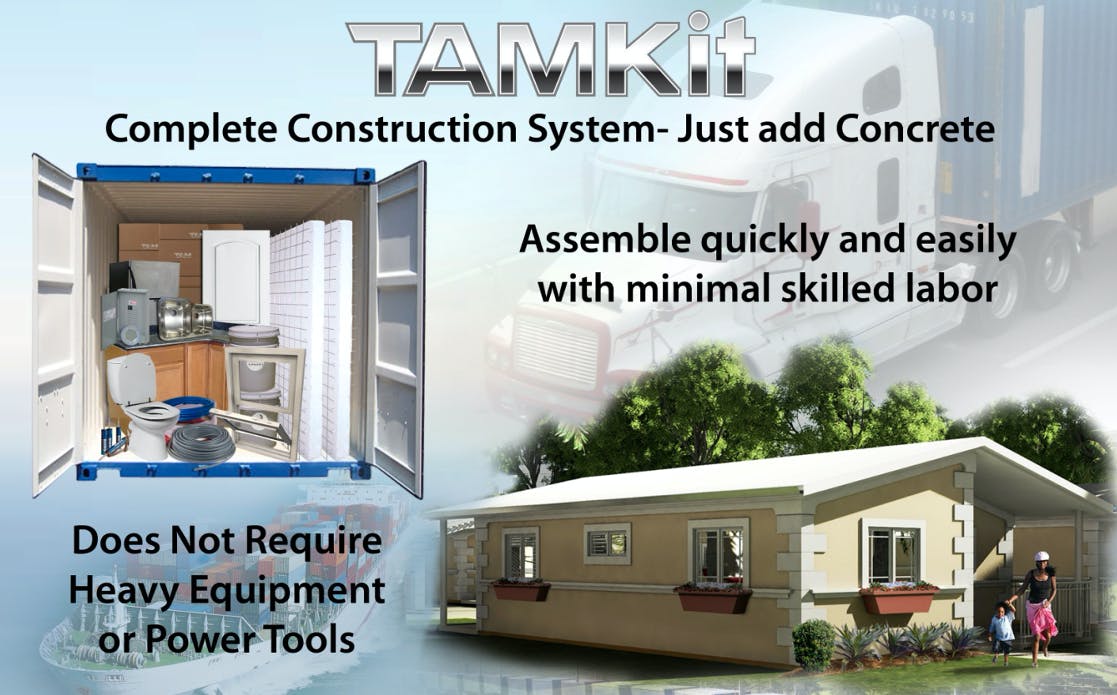
The TAM kit as seen in a business plan. The company promised to revolutionize affordable housing around the world, but left behind debt and unpaid taxes.
From the Titan Atlas Manufacturing business plan
Perez met with Junior one final time at Trump Tower still hoping for some kind of refund. “I looked up to the guy,” he said. “And I thought maybe face to face Don would see it was crazy not to give us back the money.” But instead, Trump Jr. told him something that he says he will never forget. “Don said, ‘Look, Carlos, you know my father,’” Perez recalled. “‘If my father would have been dealing with this, he would have sued you guys a long time ago.’ I knew…
