
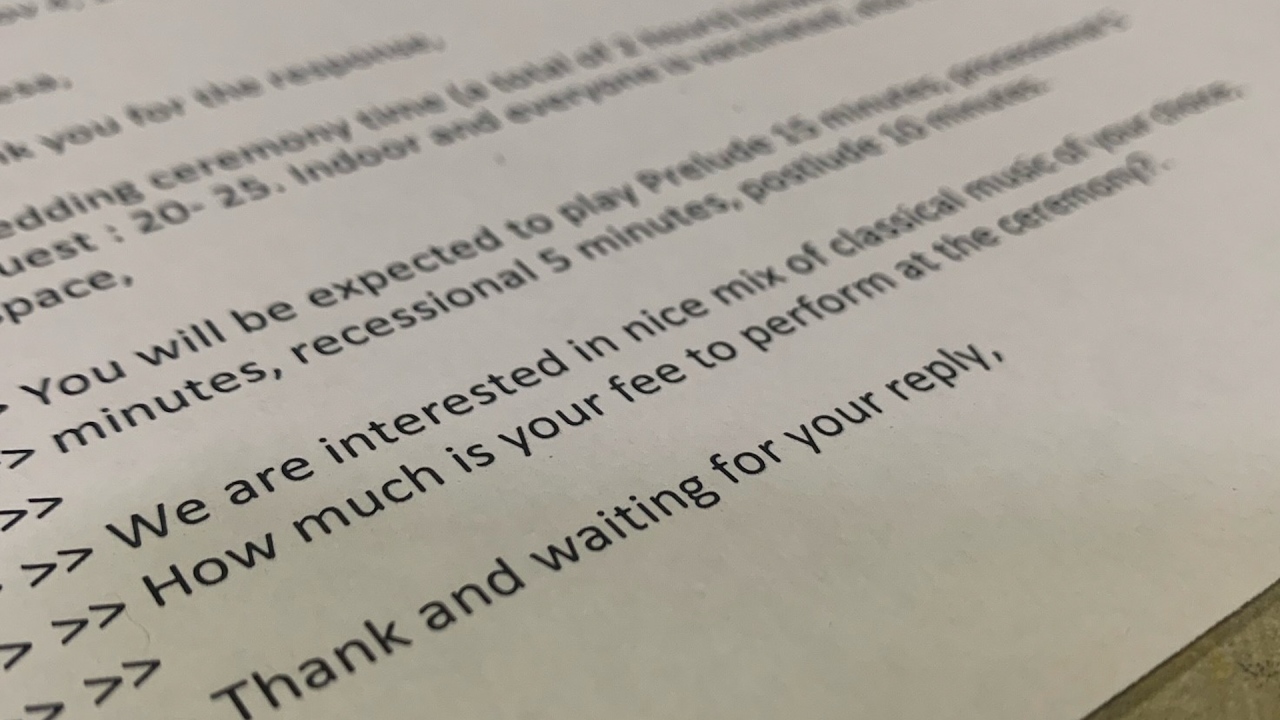
INDIANAPOLIS — As soon as Teresa Shunk read it, her guard was already down.
“That’s an email that musicians get like fairly regularly,” she said.
Shunk, a music education major at DePauw University in Greencastle, said it’s not unusual for music students to be requested to play gigs. So when she got an email from her professor, forwarding a request to play at an event, it seemed to check out.
“They emailed my piano professor, saying that they were looking for a pianist to play for their wedding,” said Shunk.
Over the course of several days, Shunk communicated with the person, who went by Jennifer, discussing specifics through text and email.
“The only thing they weren’t specific about is when I tried to ask them, like what type of music do you want? Is this sort of music good? They were like ‘Oh it’s fine, whatever you choose,’” she said, “That was probably maybe one of the first warning signs that I could’ve picked up on like, hmmm… Why do they not care?”
When it came time to discuss payment, they decided on $200, and a check would be sent to Shunk through the mail.
However, when the check arrived, it was for $1,900.
“They told me that they had accidentally written me a check that was too large,” she said.
“Jennifer” claimed they overpaid Shunk, accidentally lumping the sum for both her and the photographer. To make up for the mistake, Shunk said they asked her to keep $200 and send back $1,700 through a PayPal address.
“I believe I deposited the check on Monday,” she said. “The funds went through probably the next day, and it wasn’t until Friday that the check bounced finally and the funds left my account.”
Shunk was out of $1,700.
“I was like holy crap, what just happened?” she said.
Shunk’s story is one of the many highlighted during National Consumer Protection Week, a national effort started more than 20 years ago by the Federal Trade Commission.
“The counterfeit check scams, we see that across the various different types of frauds,” said U.S. Postal Inspector Kathy Woliung.
Counterfeit check scams, as well as work from home scams, continue to trick countless people across the country, and officials said they’re only becoming more creative.
“You can pull up Google Maps. You can go to DePauw University, and you can find out who the professor is,” said Woliung. “You can find out what they teach, maybe what kind of students they’re going to have in their class. So information is readily available for the scammers.”
Woliung said these scams can be hard to trace as they often originate outside of the U.S., but there are ways to protect yourself.
“The old adage if it’s too good to be true, it’s too good to be true,” Woliung said.
Some of the red flags, Woliung said, are ads that promise a work from home job without an interview, or overpaid checks sent to you for a purchase or job.
“If they’re asking you to cash a check, keep a little bit of the money for yourself, and then send the rest of the money out through wire, whether it be through a work from home scam or maybe you just sold something on Facebook Marketplace,” Woliung said. “If they’re asking you to do that, most people aren’t going to trust that you’re going to send them back the money.”
Officials also recommend not giving out personal information, like your Social Security number or banking information. If you’re unsure, you can vet a business or company through a site like Better Business Bureau or the Attorney General’s Office.
USPIS is currently investigating Shunk’s case, so they can’t comment on it specifically. However, they urge anyone who may feel victim to a similar scam, or any scam where U.S. mail is involved, to report it to them.
“We build our cases on the complaint. So don’t feel like anything is too small. Even if you didn’t lose money, it may be worth reporting it so we can investigate,” Woliung said.
You can report cases to USPIS online or by calling 877-876-2455.
As for Shunk, she’s hopeful others learn from her mistake and listen to their gut.
“If you have those little suspicions because there were little clues, they weren’t big, but they were little clues that maybe this is a little fishy, it’s not worth it,” she said.
