
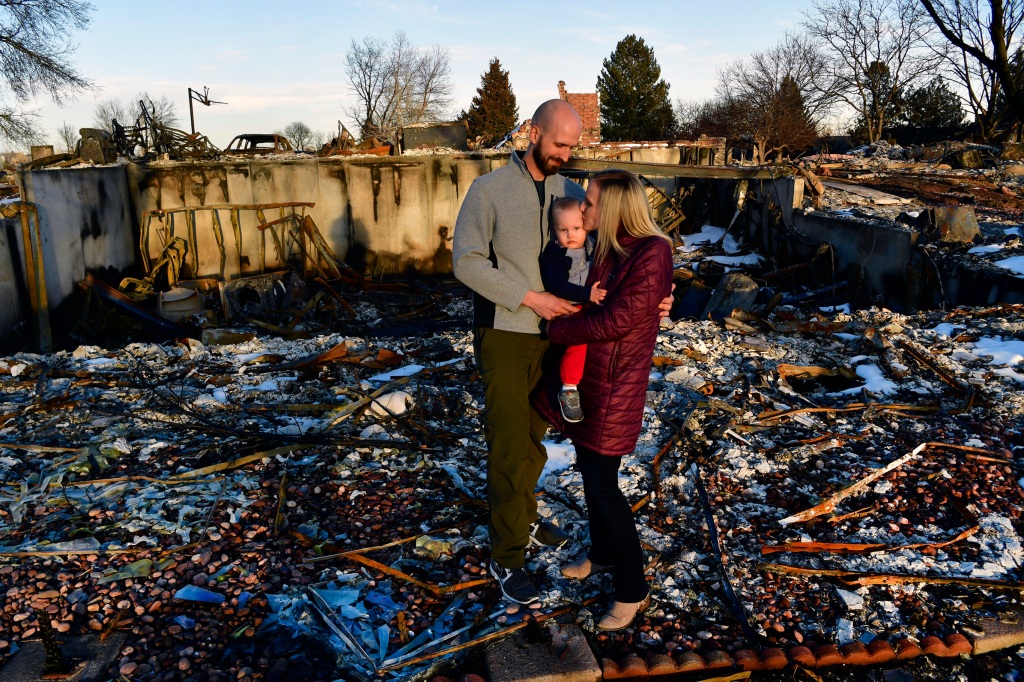
When Dave Baron and his wife Kim Meyer closed on their new home on Mulberry Street in Louisville on Aug. 31, they believed they had all the insurance they would need should catastrophe strike.
Four months later, catastrophe came in the form of a 6,000-acre winter wildfire fueled by hurricane-force winds. Their $1.3 million home, with its hardwood floors, decorative arches, finished basement and “really cool metal banisters,” was destroyed.
To compound the tragedy, Baron and Meyer now are finding their insurance coverage wasn’t enough. The family’s policy will only cover about a third of the construction cost to rebuild the home, Baron said, and he blames the insurance company for underestimating exactly how expensive it is to build in today’s market.
“We are not able to afford at this time to move back into a home that we lost in a community we love,” Baron said. “We want people to know this is a rampant problem in the community. They’re setting their rebuild limits extremely low and it’s going to bankrupt people who are trying to rebuild their homes.”
It’s too early to know how many of the 1,084 homeowners who lost their houses in the Marshall fire were underinsured, but there’s been enough noise from those who believe they are that elected officials are paying attention. Homeowners have attended local government meetings to ask for help. They’ve called the Colorado Division of Insurance. They’re forming groups to fight together.
Those in the thick of the crisis, including the state’s insurance commissioner, are sounding the alarm that more Colorado homeowners might hold insurance policies that fall short of the coverage needed to rebuild. And as wildfires become more frequent and more destructive amid a warming climate, this will be a continuing problem.
“This has been a problem for a long time, and it’s not just localized to this time and place,” said Erin Lindsay, who estimates her insurance policy will leave her about $500,000 short of the money needed to replace her Louisville home. “Policies are being written up for wildly inappropriate amounts. The limits are just wildly wrong.”
She added, “Wildfires are going to continue to happen. This is going to be a concern in the future.”
Helen H. Richardson, The Denver Post
An aerial view of the destruction left by the Marshall fire in Louisville on Jan. 2, 2022.
The underinsurance problem is exacerbated by just how expensive new home construction has become in Colorado during the pandemic, with supply chain backups, labor shortages and rising inflation.
People associated with the insurance industry say it’s too early for Marshall fire victims to panic over their coverage. Rebuilding is months — maybe years — away and a lot can change between now and then. And some people may have more insurance than they realize, said Carole Walker, executive director of the Rocky Mountain Insurance Information Association.
“Don’t get too far ahead of yourself before we put a nail to a board,” Walker said.
But United Policyholders, a national nonprofit organization that advocates for and educates homeowners about insurance, says underinsurance is a chronic problem in the United States when disasters strike. After wildfires, the group surveys victims and consistently finds about two-thirds of the people who lose homes report being underinsured, said Amy Bach, executive director of United Policyholders.
That was the case after the massive East Troublesome fire burned through Grand County in October 2020, according to survey data from United Policyholders. The group sent a questionnaire to wildfire victims and at least 112 responded. Of those, 79 answered the question asking whether they had enough insurance, and 64% of those respondents said no. Another 7.6% said they didn’t know.
“It is a real fear because it is true,” Bach said.
The Marshall fire comes at a terrible time for those who need to build a new home.
Already, the Front Range is facing an unprecedented housing shortage, whether it’s people looking to rent or buy. At the same time, ongoing supply chain issues are causing the prices of building materials to skyrocket, and the labor shortage is making it impossible to build new homes quickly.
A month before the fire, the Louisville City Council adopted a local ordinance requiring all new home construction to meet a net-zero energy standard by including solar panels, energy-efficient windows and other features, making the cost to build a new home increase.
Historically, home construction prices surge after a wildfire, said Walker, who represents the home, auto and business insurance industry in Colorado, New Mexico, Utah and Wyoming.
“That happens every time we have a major hurricane, a tornado, a wildfire,” Walker said. “That happens every time because we have so many people trying to rebuild at the same time.”

Hyoung Chang, The Denver Post
Smoke rises from the Marshall fire in Boulder County, as seen from 96th Street and West Dillon Road in Louisville, on Thursday, Dec. 30, 2021.
Searching for every cent
On Dec. 30, the day the Marshall fire erupted, Baron’s family returned from dropping off his parents at Denver International Airport to see heavy smoke in their neighborhood.
“It was orange,” Baron said. “It smelled like smoke in the house, and we could see ash in the air.”
The Barons had moved from Aurora after he got a new job that required him to spend time in Boulder and Lafayette. Louisville was the perfect location, and life was good for the young couple, who married the same month they moved into the house. They’d finally finished unpacking and had just celebrated their first Christmas in the home when they saw the smoke and ash in the air.
The couple grabbed their dog, their 18-month-old son’s pack-and-play and left the house. They had planned to hold a New Year’s Eve housewarming party the next evening.
“We had to call them all the day before and say it all burned down,” he said.
The Baron family had insured their home for $392,000, which is what their insurance agent said they would need to rebuild the entire house. That leaves the family a little more than $100 per square foot to rebuild their 3,600-square-foot home. But Baron said the estimates he has received put the cost of rebuilding the same house he had at $350 to $400 per square foot.
Insurance companies advise owners that a home’s coverage amount is based on construction cost, not the actual value of a house or the sales price, which includes the land.
Baron blames his insurance carrier for failing to recommend the correct amount of insurance. He bought the policy just four months ago and it was clear then that construction costs are soaring, he said.
“This what they do for a living,” he said. “We trust them to know what the costs are.”
Now, after working all day and then taking care of their son, the couple spends late nights attempting to list everything they once owned in their home, trying to scrape together every cent available from their policy. Their families started a GoFundMe fundraising campaign to help the couple with recovery.
“Every single drawer and every single closet,” Baron said. “What items did you have? How much did it cost? How old was it? Literally, thousands of items in your house. And then you have to go to bed at some point.”

Helen H. Richardson, The Denver Post
A sign of support is placed in what was the front lawn of a home belonging to Dave Baron and his wife Kim Meyer in Louisville on Feb. 15, 2022.
Setting the base coverage
When someone looks to insure a home, they get estimates from insurance companies that use proprietary software to estimate what it would cost to build the same house. That software accounts for square footage, roofing, decks and various features of a home.
The insurance agent then recommends a dollar figure of what it would cost to replace the home from the ground up.
That dollar figure becomes the basis for other types of coverage, too. A homeowner’s insurance for contents, sheds, decks, fences and building code upgrades would be a percentage based on that dwelling number. So, for example, a policy that insures for $300,000 might have 10% for building code upgrades, or $30,000, added on.
So setting that base dwelling coverage is critical.
But even then, it’s hard to collect everything.
Before paying for destroyed contents — everything from furniture to clothes to forks to ceiling fans — homeowners often are required to itemize every single object that was in their house. They must document those things with pictures or receipts and then find the current market value to seek reimbursement.
For Mario Jannatpour, creating that list is so emotional that his family hasn’t started.
They were on a family day trip to Garden of the Gods in Colorado Springs when they heard about a wildfire tearing through their Louisville community via text message. First they heard Costco was on fire. Then a movie theater. Then a neighborhood skate park. Then the blue house across the street. And then their deck.
One of his daughters started screaming.
“Being a parent and you hear your kids in pain and agony, I wanted to die right there,” Jannatpour said.
He and his wife, Smitha Sundaresan, lost all their wedding pictures, their daughters’ childhood photographs and other cherished belongings. Their insurance policy gave them 30% of the contents’ value up front, as required by state law. To claim the rest, they must make a list and prove they once owned everything on it.
“We haven’t done it yet,” he said. “It’s way too emotional for us to go through that list.”
On top of that, the family expects their total insurance coverage to fall short of rebuilding costs by several hundred thousand dollars. Their 4,000-square-foot home, which the family bought in 2004, was valued at $1.2 million before the fire.
“We’re at a point where we can…
